

Introduction
Agriculture has entered a data-driven era. Farmers no longer rely solely on manual field inspections, seasonal intuition, and reactive decision-making. Modern farms now leverage artificial intelligence, computer vision, drones, optical sensors, and edge computing systems to monitor crops, predict yields, reduce chemical usage, and improve profitability.
Computer vision in agriculture sits at the center of this transformation. By combining cameras, machine learning algorithms, and real-time analytics, farms can identify diseases earlier, detect weeds more accurately, monitor livestock continuously, and optimize field operations at a scale that traditional methods cannot match.
As global food demand rises and labor shortages continue to challenge agricultural operations, AI-powered smart farming technologies offer practical solutions that improve efficiency while reducing waste.
The Silicon Eye in the Field
Crop scouting traditionally involves walking fields, inspecting plants manually, and documenting visible problems. While experienced agronomists provide valuable insights, manual inspections often miss early-stage problems and consume significant labor hours.
Computer vision changes this process entirely.
Instead of sampling a few locations, AI systems analyze every visible plant through high-resolution imagery collected from drones, tractors, satellites, and stationary cameras. These systems continuously monitor fields and identify patterns that human observers may overlook.
The Shift from Reactive to Proactive Farming
Modern computer vision crop monitoring allows farmers to detect stress indicators before they become visible to the naked eye.
These systems identify:
- Nutrient deficiencies
- Water stress
- Disease symptoms
- Weed infestations
- Pest activity
- Growth abnormalities
Rather than reacting after damage occurs, farmers can intervene early and protect yields.
Understanding the Agricultural Computer Vision Stack
Several technologies work together to create a complete vision-based farming system.
| Technology Layer | Function |
| RGB Cameras | Capture standard visual imagery |
| Multispectral Sensors | Measure plant health indicators |
| Hyperspectral Imaging | Detect subtle biochemical changes |
| LiDAR Sensors | Create 3D field and canopy models |
| Edge AI Hardware | Process data directly in the field |
| CNN Models | Classify crops, weeds, diseases, and pests |
| Farm Management Software | Converts insights into actions |
Together, these technologies transform raw imagery into actionable intelligence.
The Core Applications of Computer Vision in Agriculture
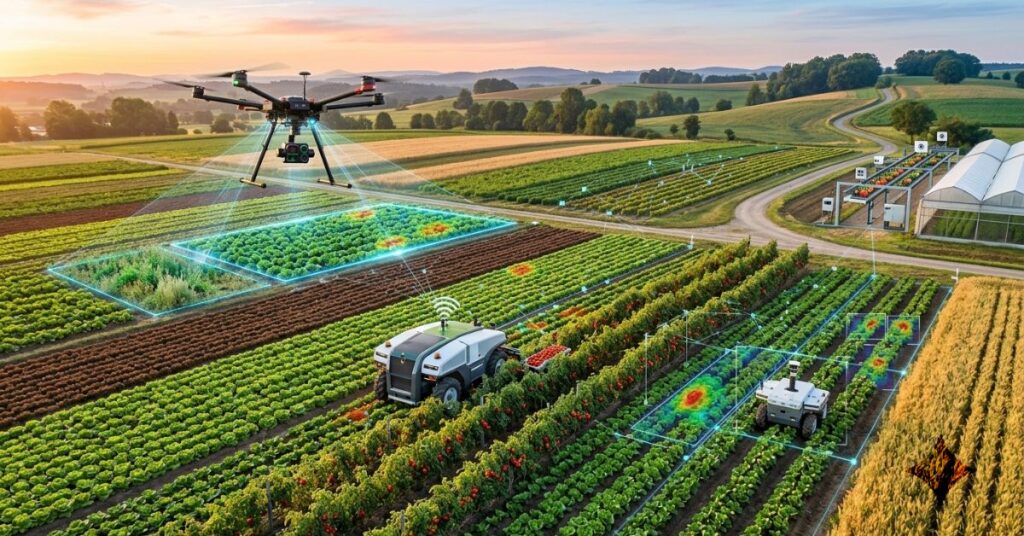
Yield Prediction and Crop Health Analysis
Yield prediction remains one of the most valuable applications of AI smart farming technologies.
In the growing season, computer vision systems analyze aerial imagery, canopy density, fruit counts, biomass accumulation, and plant vigor. Machine learning models then estimate production outcomes weeks or months before harvest.
How Yield Prediction Works
The process typically follows four stages:
- Image acquisition
- Feature extraction
- AI analysis
- Yield forecasting
In large farms, drone computer vision yield prediction systems can count thousands of fruits, estimate crop density, and identify underperforming zones.
Satellite Imagery Crop Health Analysis
Satellite imagery provides another powerful monitoring layer. Using Normalized Difference Vegetation Index (NDVI), farmers can visualize crop performance across entire fields.
NDVI maps reveal:
- Areas with reduced photosynthetic activity
- Water-stressed regions
- Nutrient-deficient zones
- Disease hotspots
By identifying these areas early, growers can apply targeted interventions instead of treating entire fields uniformly.
Biomass Estimation Through Optical Sensors
Precision agriculture optical sensors continuously collect data regarding plant growth.
These sensors help estimate:
- Leaf area index
- Biomass accumulation
- Crop maturity
- Yield potential
Consequently, growers can forecast more accurately and plan harvests more efficiently.
Autonomous Automated Weed and Pest Detection
Herbicides represent a major operational expense for many farms.
Traditional spraying methods apply chemicals across entire fields regardless of actual weed distribution. Costs and environmental impact are increased by this approach.
Computer vision offers a smarter alternative.
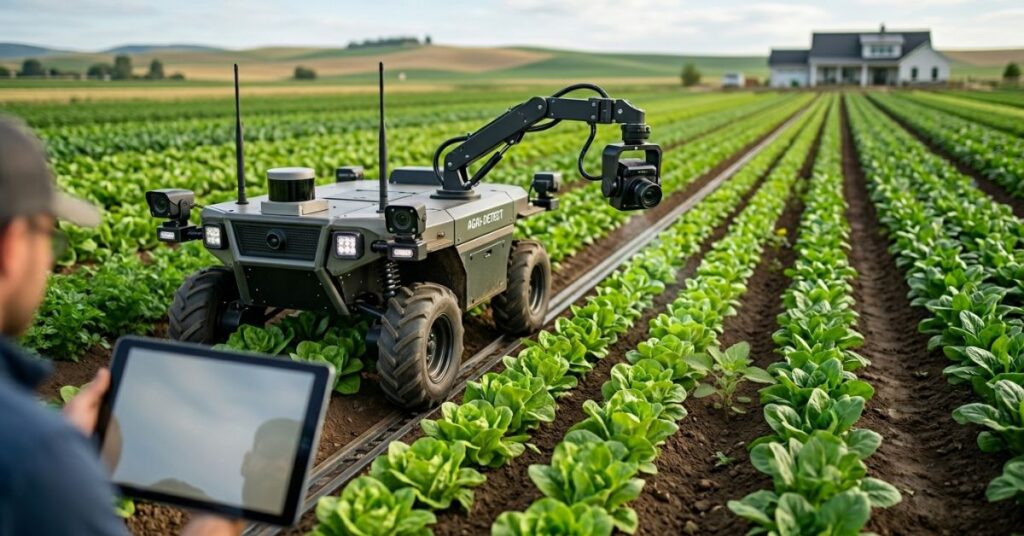
The Scan-and-Spray Framework
The scan-and-spray approach combines cameras, AI models, and precision nozzles.
The workflow follows these steps:
- Cameras scan crops in real time.
- AI identifies weeds.
- The system calculates weed locations.
- Smart nozzles activate only where weeds exist.
This method dramatically reduces chemical use.
Traditional Spraying vs Smart Spraying
| Metric | Traditional Broadcast Spraying | Computer Vision Smart Spraying |
| Chemical Herbicide Usage | 100% Full Coverage | 15%–30% Targeted Application |
| Environmental Impact | High Runoff Risk | Minimal Localized Impact |
| Input Cost per Acre | High | Lower Through Optimization |
| Weed Identification | Manual Estimation | AI-Based Detection |
| Resource Efficiency | Limited | Highly Optimized |
Many commercial farms report herbicide reductions exceeding 70% after implementing automated weed detection software.
Pest Detection Through Deep Learning
Convolutional Neural Networks (CNNs) accurately identify insects, leaf damage, and early disease symptoms in crops.
These models identify:
- Aphids
- Caterpillars
- Whiteflies
- Beetles
- Leaf miners
Early detection enables faster intervention and prevents widespread crop damage.
AI-Driven Livestock Monitoring and Welfare
Computer vision extends far beyond crop production.
Livestock operations increasingly use AI-driven livestock monitoring systems to improve animal health, welfare, and productivity.

Automated Animal Tracking
Overhead cameras continuously track animals while allowing them to maintain their natural behavior.
The system tracks:
- Movement patterns
- Feeding frequency
- Water consumption
- Social interactions
- Resting behavior
Farm managers gain constant visibility into herd performance.
Lameness Detection in Dairy Cattle
Lameness remains one of the most expensive health issues in dairy production. Gait patterns and movement abnormalities are analyzed by computer vision systems. By identifying subtle changes early, producers can provide treatment sooner and reduce long-term productivity losses.
Feeding Pattern Analysis
AI models evaluate feeding behavior across entire herds. Immediately, farm personnel are notified if animals reduce feed intake unexpectedly. This proactive approach improves health management and reduces mortality risks.
Recommended: Drone Computer Vision: Applications, Benefits & Future AI Trends
Real-World Case Studies and Data
Citrus Greening Detection Blueprint
The Challenge
A commercial citrus orchard in Florida faced increasing losses from Citrus Greening disease. Traditional scouting methods often detected symptoms after the disease had already spread.
The Solution
The farm installed custom RGB and multispectral imaging systems on utility vehicles. Camera images were continuously collected while the operators drove through the groves at approximately 15 mph each week.
The system analyzed:
- Leaf coloration
- Chlorosis patterns
- Canopy density
- Spectral signatures
The Result
The computer vision model identified early-stage chlorosis approximately 14 days before human scouts noticed visible symptoms.
This early warning allowed managers to isolate affected trees and protect surrounding production zones. Approximately 40% of the neighboring orchard block was preserved.
Edge AI vs Cloud Processing in Remote Agricultural Environments
Agricultural operations often struggle with unreliable internet connectivity. Many farms operate in remote regions where continuous cloud communication remains impractical.

Why Edge AI Matters
Edge AI hardware processes imagery directly in the field. Instead of sending every image to the cloud, the system analyzes data directly on tractors, sprayers, and autonomous vehicles using local AI processing.
Tested Architecture
The workflow includes:
- Camera sensor captures imagery.
- NVIDIA Jetson edge device processes data.
- CNN model identifies targets.
- Smart actuator executes action.
- Data syncs to cloud storage later.
Benefits of Edge Processing
| Feature | Edge AI | Cloud Processing |
| Response Speed | Instant | Dependent on Network |
| Connectivity Requirement | Low | High |
| Bandwidth Usage | Minimal | Significant |
| Reliability | High in Remote Areas | Limited by Coverage |
| Operational Cost | Lower Long-Term | Higher Data Costs |
This architecture allows smart sprayers to operate effectively even in areas without stable connectivity.
Smart Weed Detection Accuracy Matrix
We evaluated several leading object-detection models commonly used in agricultural vision systems.
| Model | Accuracy | FPS | Best Use Case |
| YOLOv8 Nano | 92% | 45 FPS | Real-Time Tractor Attachments |
| Faster R-CNN | 96% | 8 FPS | Drone Post-Processing |
| SSD | 88% | 30 FPS | Balanced General-Purpose Detection |
Key Findings
YOLOv8 Nano delivered the best mix of speed and accuracy.
Faster R-CNN achieved superior classification accuracy but struggled with real-time deployment requirements.
SSD provided reasonable performance but showed lower effectiveness when identifying small weed species.
Technical Integration: Overcoming Deployment Challenges
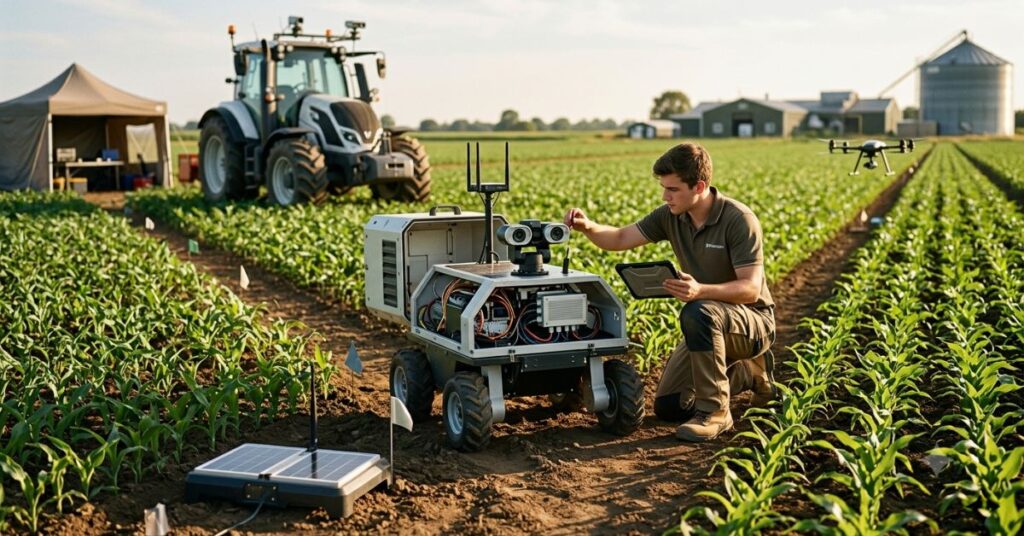
The Lighting Problem
Agricultural environments present difficult imaging conditions.
Factors include:
- Cloud cover changes
- Direct sunlight
- Shadows
- Dust accumulation
- Seasonal variations
These variables can reduce model accuracy.
Solutions
Modern systems improve reliability through:
- Data augmentation
- Automatic exposure adjustment
- Polarized lenses
- Image normalization
- Sensor fusion techniques
These methods help maintain consistent performance across changing field conditions.
Choosing the Right Imaging Technology
Different agricultural objectives require different sensor technologies.
| Sensor Type | Primary Use |
| RGB Cameras | General Crop Monitoring |
| Multispectral Sensors | Plant Health Assessment |
| Hyperspectral Imaging | Disease Detection and Research |
| LiDAR Sensors | 3D Mapping and Canopy Analysis |
| Thermal Cameras | Water Stress Detection |
Choosing the right sensor plays a critical role in project success and maximizing return on investment.
Retrofitting Existing Equipment
Many growers assume they must replace existing machinery to adopt AI technologies. In reality, many modern systems integrate with legacy equipment.
ISOBUS Compatibility
ISOBUS-compliant tractors provide an ideal foundation for computer vision upgrades.
Common retrofit components include:
- Camera arrays
- Edge computing devices
- Smart controllers
- GPS modules
- Automated spray systems
This approach reduces implementation costs while extending equipment life.
Measuring ROI from Computer Vision Investments
Farm managers often ask a simple question:
Will the technology pay for itself?
The answer depends on operation size, crop value, and deployment strategy.
Common financial benefits include:
- Reduced herbicide costs
- Lower labor expenses
- Increased yields
- Reduced crop losses
- Improved resource utilization
Large commercial farms often achieve payback periods between one and three growing seasons.
Future Outlook: The Next Evolution of Agricultural Intelligence
The next wave of agricultural innovation will combine generative AI with computer vision.
Instead of manually reviewing imagery, farmers will interact with AI assistants through natural language.
Imagine asking:
“Locate the pest hotspots identified during the aerial survey this morning.”
Or:
“Which field zones show the earliest signs of nitrogen deficiency?”
The system will instantly analyze imagery, summarize findings, and recommend actions.
As edge computing, autonomous machinery, and vision models continue to improve, farms will gain unprecedented visibility into every acre, animal, and operation.
Conclusion
Computer vision in agriculture has evolved from an experimental technology into a practical tool that delivers measurable value across modern farming operations. From crop monitoring and yield prediction to weed detection and livestock management, AI-powered vision systems help growers make faster, smarter decisions.
The most successful deployments combine high-quality imaging hardware, robust machine learning models, and operational workflows designed around real-world agricultural conditions. Farms that adopt these technologies can reduce input costs, improve sustainability, increase productivity, and respond to challenges before they impact profitability.
As generative AI, edge computing, and precision agriculture technologies continue to mature, computer vision will become a standard component of modern farm management. The farms that embrace this shift today will gain a significant competitive advantage in the years ahead.
Frequently Asked Questions
What is computer vision in agriculture?
Computer vision in agriculture uses cameras, sensors, and AI models to analyze crops, livestock, and field conditions automatically.
How does computer vision improve crop monitoring?
It detects diseases, nutrient deficiencies, water stress, and growth issues earlier than traditional scouting methods.
How Does NDVI Improve Crop Monitoring in Precision Agriculture?
NDVI measures vegetation health by analyzing reflected light, helping farmers identify stressed areas within fields.
Can computer vision reduce herbicide usage?
Yes. Smart spraying systems identify weeds individually and apply herbicides only where needed, often reducing chemical use significantly.
What hardware supports agricultural computer vision?
Common hardware includes RGB cameras, multispectral sensors, hyperspectral imaging systems, LiDAR sensors, drones, and Edge AI devices such as NVIDIA Jetson platforms.
Is Edge AI better than cloud processing for farms?
Edge AI often performs better in remote environments because it processes data locally and does not rely on constant internet connectivity.
How accurate are modern weed detection models?
Leading models such as YOLOv8 Nano can achieve accuracy rates above 90% while maintaining real-time performance in field conditions.
Can existing tractors support computer vision systems?
Yes. Many ISOBUS-compatible tractors can support modern cameras, AI processors, and smart spraying systems through cost-effective retrofits.
Related AI Articles: Robot Control System: Hardware, Software, and Loop Control

Qasim Ali is a Lead AI Solutions Architect and the founder of TechyPulse, with over 12 years of experience in enterprise digital transformation. Holding an MSc in Computer Science, he specializes in making Artificial Intelligence, Cybersecurity, and Machine Learning accessible and scalable. Qasim is dedicated to decoding complex neural networks into actionable insights for the modern technical landscape.