

Introduction
Drone technology has changed rapidly over the last few years. Modern drones no longer just capture photos or record videos from the sky. Today, companies use drones with artificial intelligence and computer vision to inspect buildings, monitor crops, track traffic, and even support emergency teams during disasters.
Drone computer vision enables drones to interpret and analyze their surroundings in real time using AI-powered visual systems. Instead of depending entirely on human operators, these smart drones automatically analyze images, detect objects, recognize patterns, and make real-time decisions during flight. Industries now use this technology to save time, reduce costs, and improve accuracy.
In this guide, you will learn how drone computer vision works, where companies use it, its biggest advantages, the challenges it faces, and the future trends shaping this technology.
What Is Drone Computer Vision?
Drone computer vision combines drone technology with artificial intelligence and machine learning. It helps drones process visual information from cameras and sensors. The drone then interprets that information to understand objects, environments, and movement.
Unlike traditional drones that simply record footage, AI-powered drones analyze visual data automatically. They can identify damaged roads, detect crop diseases, recognize vehicles, or follow moving objects without constant human control.
How Drone Computer Vision Works
Drone computer vision starts with cameras and sensors mounted on the drone. These devices capture images, videos, thermal scans, or depth information during flight. AI models then process the data in real time or after the drone lands.
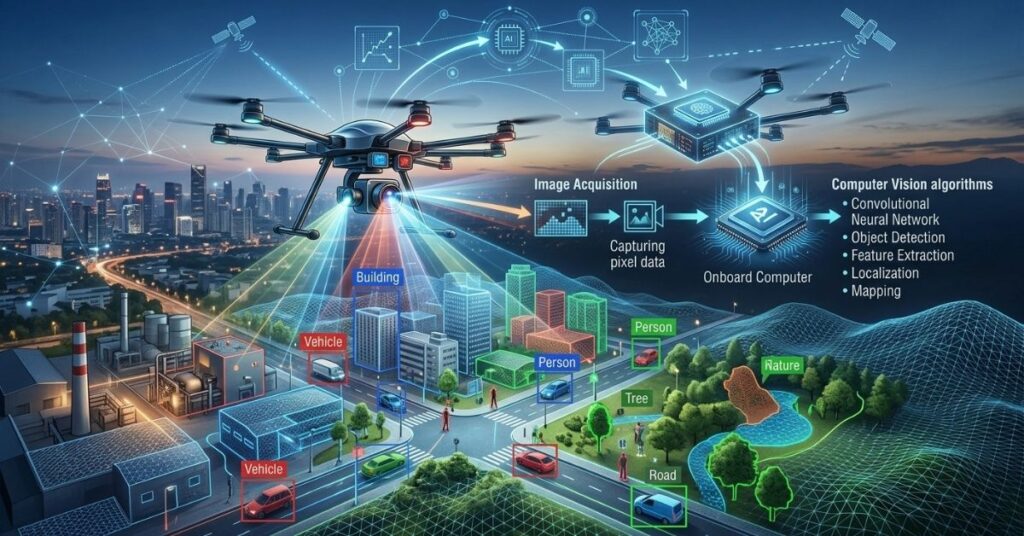
The system usually follows these steps:
| Step | What Happens |
| Data Collection | Cameras and sensors capture images and video |
| Image Processing | AI software cleans and analyzes the visual data |
| Object Detection | The drone identifies people, vehicles, crops, or structures |
| Decision Making | The system provides insights or triggers actions |
Computer vision algorithms help the drone recognize patterns and understand environments. Some drones even avoid obstacles automatically using visual recognition systems.
Key Technologies Behind AI-Powered Drones
Several advanced technologies support drone computer vision. Together, these tools help drones perform complex tasks with high accuracy.
Machine learning models train drones to recognize objects and behaviors. Deep learning algorithms improve detection accuracy over time. High-resolution cameras capture detailed visuals, while LiDAR and thermal sensors provide additional environmental data.
Edge AI also plays a major role. Instead of sending data to cloud servers for analysis, edge AI processes information directly on the drone. This approach reduces delays and improves real-time decision-making.
Difference Between Traditional Drones and Vision AI Drones
Traditional drones mainly focus on remote control flying and video recording. Human operators handle navigation, inspection, and analysis manually.
Vision AI drones work differently. They use computer vision software to analyze their surroundings automatically. These drones can detect obstacles, identify problems, and generate reports with minimal human involvement.
| Feature | Traditional Drones | Vision AI Drones |
| Navigation | Manual or GPS-based | AI-assisted autonomous navigation |
| Data Analysis | Human review required | Real-time automated analysis |
| Object Detection | Limited | Advanced AI recognition |
| Decision Making | Human-controlled | Smart automated responses |
This shift makes AI-powered drones more efficient for large-scale industrial operations.
Top Applications of Drone Computer Vision
Drone computer vision now supports multiple industries. Businesses use these systems to improve productivity, safety, and operational efficiency.

Drone Inspection for Construction and Infrastructure
Construction companies use drones to inspect buildings, bridges, towers, and roads. Instead of sending workers into risky locations, drones collect visual data safely from the air.
AI vision systems can detect cracks, corrosion, structural damage, or heat leaks quickly. Project managers also use drones to monitor construction progress and compare site conditions over time.
Infrastructure companies benefit from faster inspections and reduced downtime. Drones also improve worker safety because teams no longer need to climb dangerous structures for routine checks.
Agriculture Monitoring and Precision Farming
Farmers increasingly rely on drone computer vision for precision agriculture. Smart drones monitor crop health, irrigation patterns, and soil conditions across large farming areas.
AI-powered drones identify crop diseases early by analyzing color changes and plant patterns. Farmers are able to apply fertilizers or pesticides solely in areas where they are necessary. This approach reduces waste and improves crop yield.
Modern agricultural drones help farmers with several important tasks:
- Monitoring crop health in real time
- Detecting plant diseases early
- Tracking irrigation efficiency
- Creating accurate field maps
- Measuring soil and moisture conditions
- Reducing fertilizer and pesticide waste
Many agriculture companies now use drones to create field maps and track seasonal growth. These insights help farmers make smarter decisions throughout the growing cycle.
Surveillance, Security, and Traffic Monitoring
Security teams use drone vision systems for surveillance and public safety operations. AI drones can monitor large areas faster than traditional security methods.
Law enforcement agencies use drones to track suspicious activity, monitor crowds, and support search-and-rescue missions. Traffic departments also use computer vision drones to analyze congestion and detect accidents in real time.
Some smart city projects now integrate drone vision systems with traffic management software. These systems help authorities respond quickly to emergencies and improve road safety.
Recommended: Edge Computer Vision: Real-Time AI Systems Changing Industries
Benefits of Using Computer Vision in Drones
Drone computer vision offers major advantages across industries. Companies now rely on AI drones to improve efficiency, reduce operational risks, and speed up decision-making.
Real-Time Data Analysis and Faster Decisions
Traditional inspections often take hours or even days. AI-powered drones analyze information instantly during flight.
For example, a construction company can inspect a bridge and receive immediate alerts about structural damage. Farmers can detect irrigation problems before crops suffer major losses.
Real-time analysis allows businesses to respond faster and avoid costly delays.
Improved Accuracy and Reduced Human Effort
Computer vision systems reduce human error significantly. AI algorithms can detect patterns and defects that people may overlook.
Drones also eliminate the need for manual inspections in dangerous environments. Workers no longer need to access unstable rooftops, power lines, or high-rise structures for routine inspections.
This automation improves safety while reducing physical workload.
Cost Savings Across Industries
Many industries save money by replacing traditional inspection methods with drone computer vision systems.
Here’s how businesses reduce costs:
- Lower labor expenses
- Faster inspections and reporting
- Reduced equipment downtime
- Fewer workplace accidents
- Better resource management
Although advanced AI drones require an initial investment, companies often recover costs through long-term operational savings.
Challenges and Limitations of Drone Computer Vision
Drone computer vision presents numerous benefits; however, it continues to encounter both technical and regulatory obstacles.

Weather, Lighting, and Environmental Issues
Drone vision systems depend heavily on image quality. Poor lighting, rain, fog, dust, or strong winds can reduce accuracy.
For example, heavy shadows may affect object recognition, while fog can block cameras completely. Environmental conditions often limit drone performance in outdoor operations.
Developers continue improving sensors and AI models to handle difficult conditions more effectively.
Privacy and Regulatory Concerns
Many countries have strict drone regulations. Governments limit where drones can fly and how companies collect visual data.
Privacy concerns also create challenges. People worry about surveillance drones recording private property or personal activities without permission. Businesses must follow local aviation laws and privacy regulations carefully before deploying AI drone systems.
Companies that use drone computer vision commonly deal with challenges such as:
- Airspace restrictions in urban areas
- Data privacy and surveillance concerns
- Licensing requirements for commercial drones
- Restrictions on drone flights near airports and government areas
- Compliance with local drone safety laws
- Restrictions on recording people without consent
As drone usage increases, governments continue updating regulations to improve safety and protect public privacy.
Battery Life and Processing Limitations
Battery technology still limits drone flight duration. Most commercial drones only fly for 20 to 40 minutes before they need recharging.
AI processing also requires significant computing power. Advanced computer vision tasks can drain batteries quickly and increase hardware costs. Manufacturers continue developing lightweight processors and energy-efficient systems to improve performance.
Best Tools and Technologies for Drone Computer Vision
Developers use several powerful tools to build drone computer vision systems. These technologies support object detection, image processing, and autonomous navigation.

OpenCV, TensorFlow, and YOLO
OpenCV remains one of the most popular computer vision libraries for drone projects. Developers use it for image processing, object tracking, and motion analysis.
TensorFlow helps train deep learning models for image recognition tasks. Many AI drone applications rely on TensorFlow for machine learning workflows.
YOLO, which stands for “You Only Look Once,” specializes in real-time object detection. It allows drones to recognize vehicles, people, animals, and obstacles quickly during flight.
| Technology | Main Purpose |
| OpenCV | Image processing and tracking |
| TensorFlow | Machine learning and AI model training |
| YOLO | Real-time object detection |
These technologies allow developers to create smarter, faster, and more reliable drone vision systems.
Edge AI and Embedded Vision Systems
Edge AI allows drones to process data directly on onboard hardware instead of relying completely on cloud computing.
This technology improves speed and reduces internet dependency. Drones can make decisions instantly without waiting for remote server responses.
Embedded vision systems also improve efficiency by combining cameras, processors, and AI models into compact hardware platforms.
Industries that require real-time analysis, such as defense and autonomous inspection, benefit greatly from edge AI systems.
Popular Drone Platforms for AI Vision Projects
Several drone platforms support AI and computer vision development. Developers often choose drones based on camera quality, processing power, and software compatibility.
Popular platforms include DJI enterprise drones, NVIDIA-powered drone systems, and custom-built AI drones for industrial applications.
Many developers also prefer open-source drone frameworks for testing, research, and custom AI experiments. These platforms allow greater flexibility for machine learning integration.
Future of Drone Computer Vision
Drone computer vision continues to evolve rapidly. Advances in artificial intelligence, sensors, and robotics will push this technology even further in the coming years.
Autonomous Navigation and Smart Drones
In the future, drones will depend less on human operators. Autonomous drones will navigate complex environments using AI vision systems and advanced sensors.
These drones will avoid obstacles, select flight paths, and complete missions independently. Delivery services, warehouse management, and emergency response teams will benefit from fully autonomous drone systems.
As navigation technology improves, smart drones will become more reliable in crowded urban environments.
AI Trends Shaping Drone Vision Technology
Several AI trends continue shaping the future of drone computer vision.
Deep learning models now improve object recognition accuracy dramatically. Edge AI chips allow faster onboard processing with lower power consumption. Companies also combine drones with 5G networks for faster communication and real-time cloud integration.
Another growing trend involves swarm drones. These systems use multiple AI-powered drones that coordinate together for mapping, surveillance, and disaster response operations.
The combination of AI, robotics, and automation will expand drone capabilities across nearly every major industry.
Frequently Asked Questions
What is drone computer vision used for?
Drone computer vision helps drones analyze visual data automatically. Industries use drone computer vision for inspections, crop monitoring, surveillance, mapping, and autonomous navigation.
How does AI improve drones?
AI allows drones to recognize objects, avoid obstacles, process real-time data, and make decisions without constant human control.
Which industries use drone computer vision the most?
Construction, agriculture, security, logistics, mining, energy, and transportation industries use drone computer vision widely.
What software supports drone computer vision projects?
Developers commonly use OpenCV, TensorFlow, YOLO, and edge AI platforms for drone vision applications.
What challenges affect drone computer vision?
Weather conditions, privacy regulations, battery limitations, and processing requirements remain the biggest challenges.
Conclusion
Drone computer vision has changed how industries collect, process, and analyze data. Instead of relying only on manual inspections and human observation, businesses now use AI-powered drones to detect problems, monitor environments, and improve operational efficiency. From construction sites to large farms, smart drones continue to deliver faster and more accurate results.
The future of drone computer vision looks even more exciting. Advances in artificial intelligence, edge computing, and autonomous navigation will drive the development of smarter and more advanced drones in the coming years. As technology continues to improve, more industries will use AI-powered drone systems to save time, lower costs, and make faster, data-driven decisions in real time.

Qasim Ali is a Lead AI Solutions Architect and the founder of TechyPulse, with over 12 years of experience in enterprise digital transformation. Holding an MSc in Computer Science, he specializes in making Artificial Intelligence, Cybersecurity, and Machine Learning accessible and scalable. Qasim is dedicated to decoding complex neural networks into actionable insights for the modern technical landscape.