

Introduction
Farming no longer depends only on machinery and manual labor. Farmers now deploy intelligent systems that see, decide, and act in real time. Precision agriculture robotics leads this shift.
These systems combine AI, sensors, and autonomous machines to handle farming tasks with high accuracy. They reduce waste, cut costs, and increase crop yield consistency. More importantly, they solve labor shortages and environmental pressure at the same time.
This guide breaks down how autonomous farming robots work, where they deliver real value, and how farms integrate them at scale.
What is Precision Agriculture Robotics
Precision agriculture robotics uses autonomous machines that perform farming tasks with minimal human intervention. These robots rely on AI models, sensors, and real-time navigation systems.
Farmers use them for:
- Weed control without chemicals
- Crop harvesting with precision grip systems
- Soil analysis and mapping
- Targeted spraying and fertilization
Core Technologies Behind the System
Modern agricultural robots depend on a tightly connected tech stack:
- LiDAR sensors map terrain and detect obstacles
- Computer vision identifies crops, weeds, and ripeness levels
- GNSS navigation guides field-level movement with centimeter accuracy
- Edge computing processes data directly on the machine
- Actuators execute physical movement like cutting or picking
- Variable Rate Application (VRA) adjusts inputs based on crop need
Each system works together in real time, not in isolation.
Autonomous Farming Robots: How They Operate in Real Fields
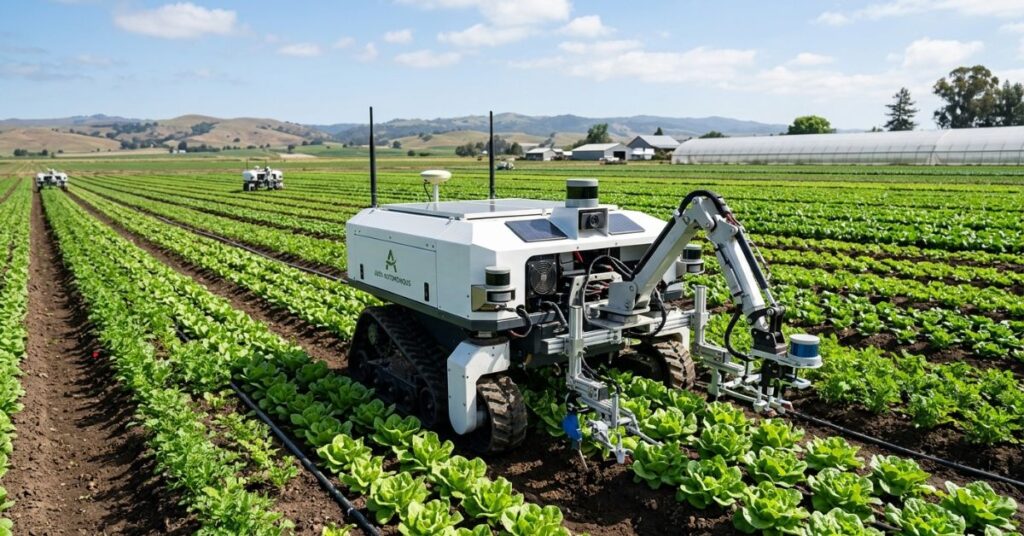
Autonomous farming robots do not follow fixed paths like traditional tractors. They adapt constantly based on environmental input.
Step-by-Step Operational Flow
- The robot scans the field using LiDAR and stereo cameras
- AI models identify crops, weeds, and obstacles
- The navigation system plots an optimized path
- Edge computing units process decisions instantly
- Actuators execute physical actions like spraying or cutting
This loop runs continuously while the robot moves through the field.
Autonomous Vision Stack
Here’s how a typical vision pipeline works:
[Stereo Camera + LiDAR] → [Edge AI Processing Unit] → [Hydraulic Actuator Arm]
- Scans crop structure and weed presence
- Runs YOLO-based detection models in real time
- Executes millimeter-level mechanical actions
This structure enables precision at machine speed, not human speed.
AI in Agricultural Robotics: The Decision Engine
AI acts as the brain of agricultural robots. It processes massive field data in seconds and decides what action to take.
What AI Actually Does in Farming Robots
- Classifies crops vs weeds with visual models
- Detects crop stress using multispectral imaging
- Predicts yield patterns using historical field data
- Adjusts robotic movement based on soil and weather conditions
AI does not just observe. It continuously decides and optimizes.
Robotic Weed Control Systems: A Shift Away from Chemicals
Weed control used to depend heavily on herbicides. Robotics now changes that approach.
How Robotic Weed Control Works
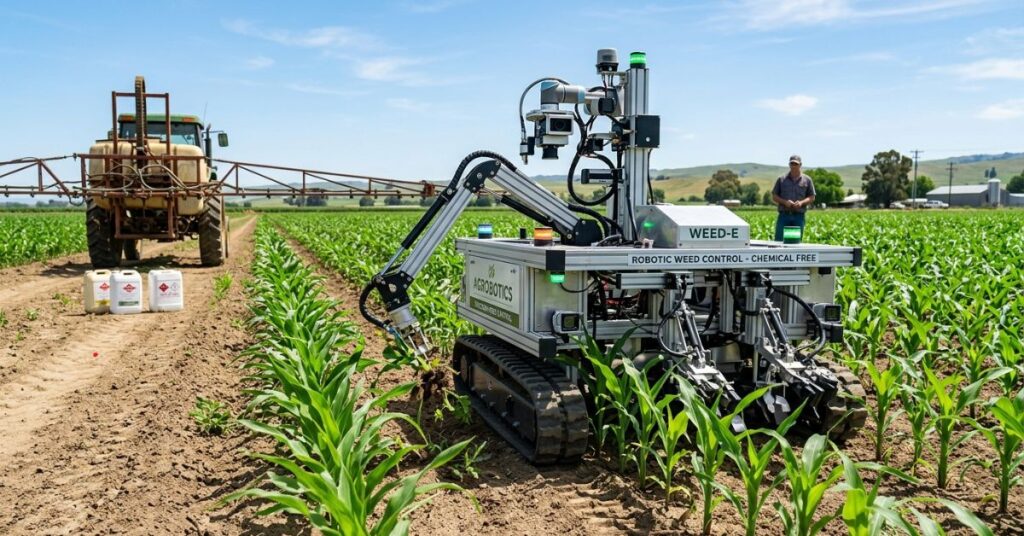
Robots scan each plant individually. They classify weeds using computer vision. Then they remove them using mechanical tools or laser systems.
Laser Weeding Technology in Agriculture
Laser weeding systems target weeds with sub-millimeter accuracy. They burn plant cells without disturbing soil.
Key advantages:
- Eliminates chemical herbicides
- Protects soil microbiome
- Reduces water contamination
- Improves organic farming compliance
Autonomous Fruit Harvesting Machines: Precision at Scale
Fruit harvesting creates one of the hardest challenges in agriculture. Robots now handle it with increasing accuracy.
How Harvesting Robots Work
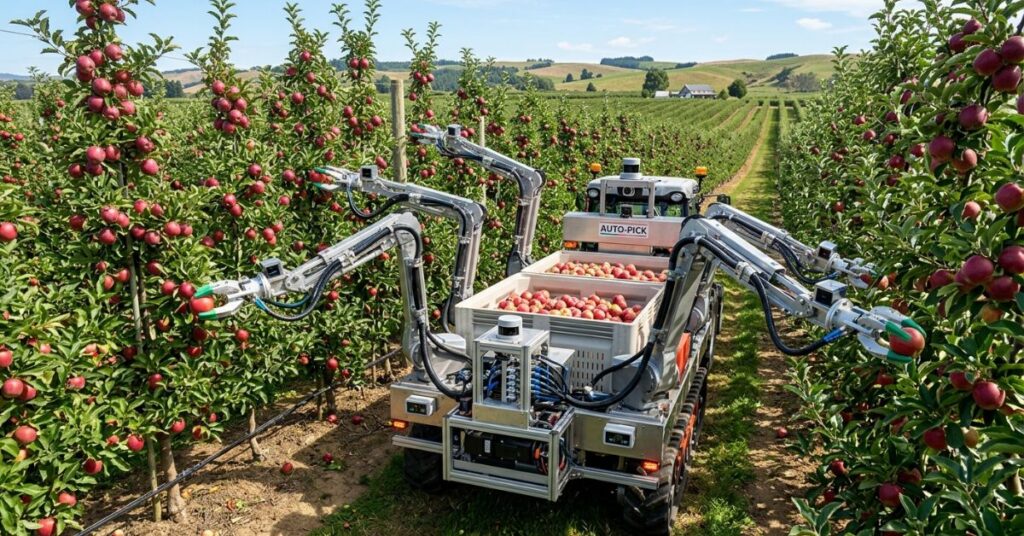
- Cameras detect ripeness using color and texture analysis
- Robotic arms position carefully around fruit
- Soft-grip actuators pick without damage
- Systems sort produce by size and quality instantly
Benefits of Autonomous Harvesting
- Reduces crop damage during collection
- Works continuously without fatigue
- Maintains consistent grading quality
- Reduces dependency on seasonal labor
Robotics for Crop Yield Optimization
Robotics improves yield by controlling inputs at micro levels.
How Optimization Happens
- Robots apply water only where soil moisture drops
- Fertilizers adjust based on plant health
- Machines map field variability in real time
- Systems store data for future crop cycles
This process turns farming into a data-driven system.
Precision Robotics for Soil Health Management
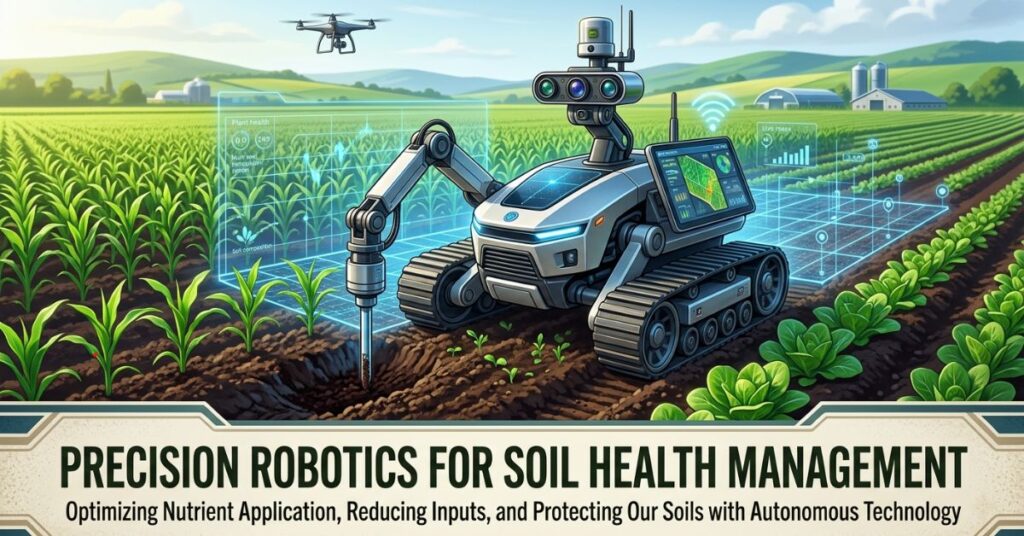
Robots now support soil health management by:
- Soil moisture monitoring
- Nutrient distribution tracking
- Reduced soil compaction
- Targeted fertilization
These improvements help farmers maintain long-term soil productivity instead of short-term yield spikes.
Recommended: Robot Control System: Hardware, Software, and Loop Control
Field-Tested ROI Metrics: Real Performance Data
Farmers always ask one question: does it actually pay off?
We break down a 1,000-acre comparison between traditional farming and autonomous robotics.
Comparative Performance Table
| Metric | Traditional Farming | Autonomous Robotics |
| Labor Hours per Acre | 8–10 hours | 2–3 hours |
| Fuel Consumption | High diesel usage | 35–50% reduction |
| Herbicide Use | Full-field spraying | Targeted application (70% reduction) |
| Crop Yield Efficiency | Baseline | +12–18% improvement |
| Operational Downtime | Frequent | Minimal |
| Input Waste | High | Low |
Key Insight
Autonomous systems reduce operational waste more than they reduce labor. That creates long-term ROI growth instead of short-term savings only.
Cost-Benefit Analysis of Autonomous Farm Equipment
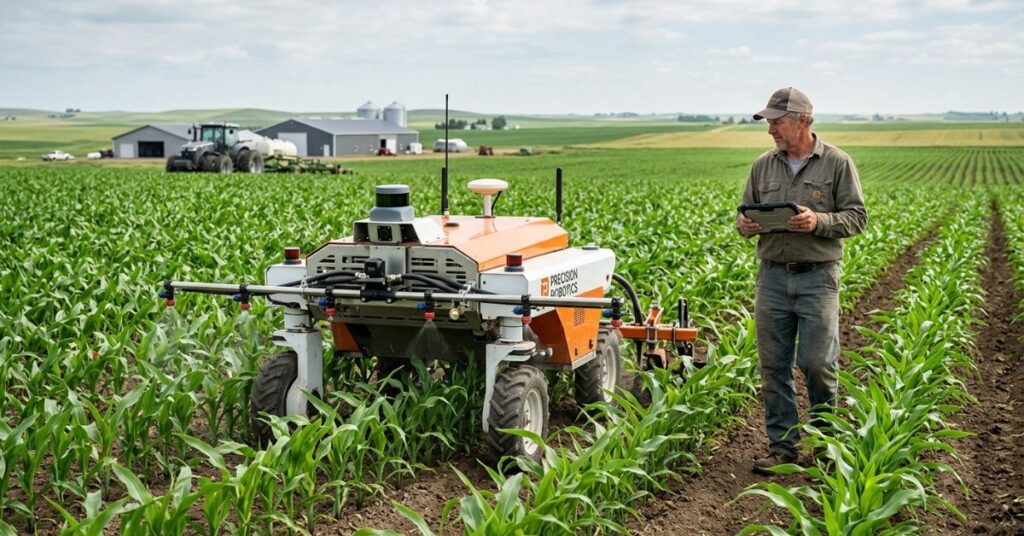
Autonomous equipment requires high upfront investment, but it reduces long-term operational costs.
Key Financial Drivers:
- Reduced labor dependency
- Lower chemical input costs
- Fuel efficiency gains
- Increased yield consistency
- Reduced equipment downtime
Operational savings and yield improvements allow most farms to recover their investment costs within 5–7 years.
Case Study: Laser vs Chemical Weed Control 2026 Trial
A commercial organic vegetable farm tested laser weeding systems over a full growing season.
Setup
The farm replaced manual and chemical weeding with autonomous laser-guided robots. The system scanned rows continuously and removed weeds without soil disruption.
Results
- 92% reduction in hand-weeding costs
- Zero chemical herbicide usage
- No soil compaction issues
- Improved soil moisture retention
- Higher organic certification compliance
Key Learning
The farm did not just reduce costs. It also improved soil health, which increased long-term productivity.
System Integration Blueprint: Connecting Robots to Farm Systems
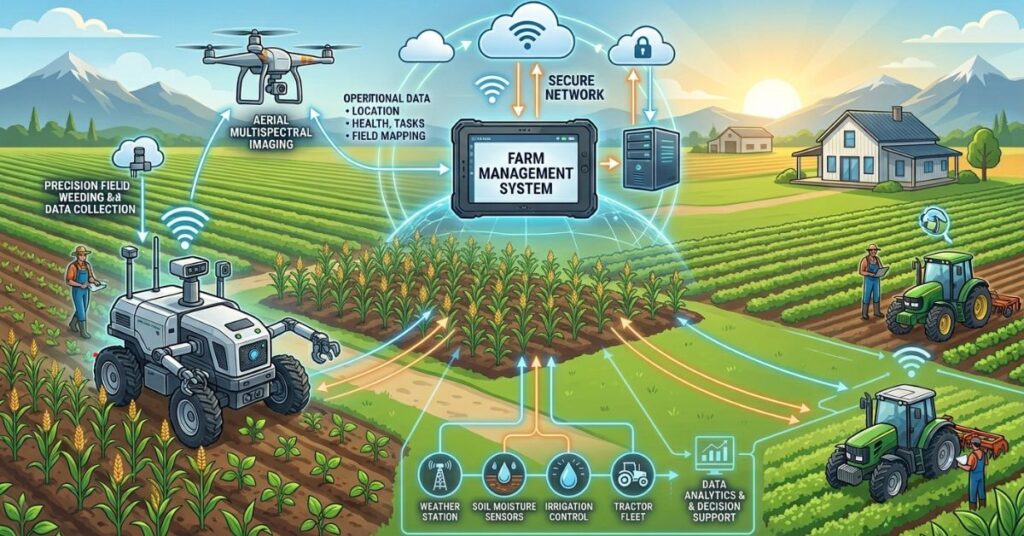
Robotics alone does not solve farming problems. Integration defines success.
Step-by-Step Integration Framework
1. Connect Edge Devices to FMIS
Farmers link robots to Farm Management Information Systems (FMIS) using secure APIs.
2. Stream Telemetry Data
Robots send real-time data:
- Soil moisture readings
- Crop health metrics
- GPS field coverage logs
3. Sync Cloud Databases
Cloud systems store and analyze long-term trends.
4. Trigger Automated Decisions
The system adjusts irrigation, spraying, or harvesting schedules automatically.
Real-World Connectivity Problem: Zero Signal Zones
Farms often operate in low-connectivity areas. Engineers solve this using:
- Edge caching systems
- Store-and-forward data queues
- Mesh network relays between machines
- Offline-first telemetry protocols
This setup ensures robots continue working even without internet access.
Scalability Challenges in Large-Scale Farming
Robotics brings major benefits, but scaling creates challenges.
Key Challenges
- High upfront equipment cost
- Training requirements for operators
- Maintenance complexity
- Terrain variation across fields
- Data synchronization across fleets
How Farms Solve These Issues
- Leasing robotic fleets instead of buying
- Using modular robotic systems
- Training hybrid human-robot teams
- Standardizing data formats across equipment
Commercial Agricultural Drones vs Ground Robots
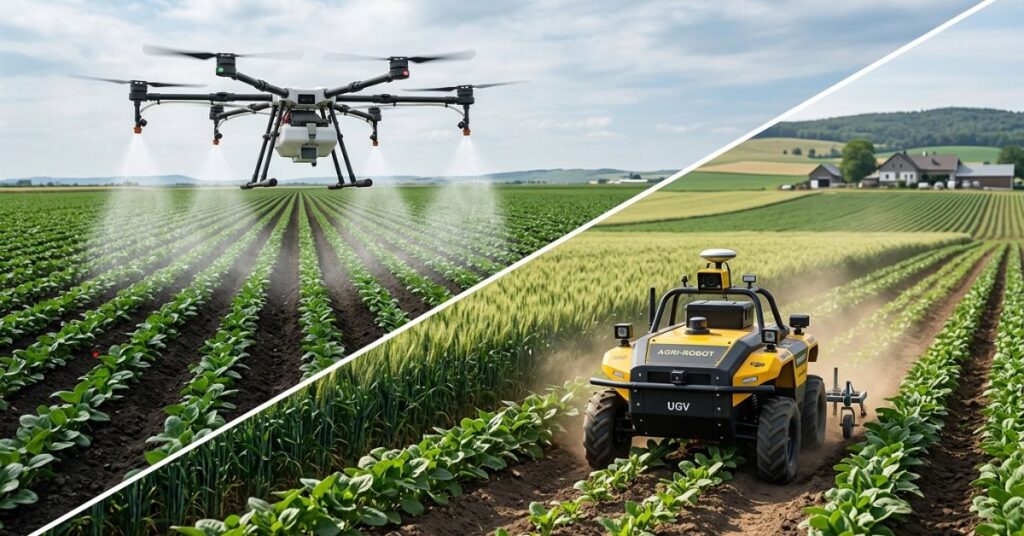
Farmers often compare aerial and ground systems.
Key Differences
- Physical tasks cannot be performed by drones, but they can scan fields.
- Weeding and harvesting are carried out by ground robots
- Drones work best for mapping and monitoring
- Ground robots handle intervention-based tasks
Both systems work better together than separately.
FAQs
1. How do precision agriculture robots decide what to do in real time?
They use AI, sensors, and edge computing to instantly analyze field data like crops, soil, and weeds, then decide actions such as spraying, harvesting, or removing weeds without human input.
2. How do autonomous farming robots work?
They scan fields, analyze data with AI, plan paths, and execute tasks using robotic actuators in real time.
3. Do farming robots replace human workers?
They reduce repetitive manual work, but humans still manage operations, maintenance, and decision-making.
4. What is laser weeding technology?
It uses focused laser beams to destroy weeds at a cellular level without chemicals or soil damage.
5. Is precision agriculture cost-effective?
Yes, farms recover costs through reduced labor, lower chemical use, and higher yield efficiency over time.
6. What crops benefit most from agricultural robotics?
Row crops, orchards, vineyards, and high-value vegetable farms gain the most benefit because robotic systems can operate efficiently in structured growing environments.
7. What are the biggest challenges of precision agriculture robotics?
The main challenges include high initial investment, maintenance complexity, connectivity limitations in rural areas, and the need for operator training. Many farms address these issues through phased deployment and robotic fleet leasing programs.
Conclusion:
Precision agriculture robotics reshapes how farms operate. It replaces guesswork with real-time intelligence, enables targeted chemical application instead of bulk usage, and eliminates manual labor bottlenecks through autonomous fleet operations.
Farms that adopt these systems do not just improve efficiency. They redesign their entire production model around data, automation, and precision control.
In many farms, robotics isn’t about full automation. It is the ability to make thousands of small decisions more accurately than traditional methods. Whether identifying individual weeds, adjusting fertilizer rates, or harvesting fruit at the right ripeness stage, precision agriculture robotics helps convert field variability into measurable operational gains.
That shift is why adoption continues to expand across both large commercial farms and specialized crop operations.
Related AI Articles: AI Business Context Refinement 2026 Guide for Enterprise ML

Qasim Ali is a Lead AI Solutions Architect and the founder of TechyPulse, with over 12 years of experience in enterprise digital transformation. Holding an MSc in Computer Science, he specializes in making Artificial Intelligence, Cybersecurity, and Machine Learning accessible and scalable. Qasim is dedicated to decoding complex neural networks into actionable insights for the modern technical landscape.