

Introduction
Edge computer vision is transforming how businesses use AI by processing visual data directly on local devices rather than on cloud servers. This approach enables faster responses, stronger privacy, and more reliable system performance with minimal delay.
Industries are adopting edge computer vision across manufacturing, healthcare, retail, autonomous systems, agriculture, and surveillance. Companies want real-time insights without depending on unstable internet connections or expensive cloud infrastructure. That demand continues to push computer vision on edge devices into mainstream adoption.
In this guide, you will learn how edge computer vision works, which hardware and software platforms lead the market, where businesses use it, and how developers build scalable edge AI systems in real-world environments.
What Is Edge Computer Vision and Why Does It Matter?
Edge computer vision combines AI vision models with edge computing to process visual data closer to the source instead of cloud servers. An edge AI camera can detect objects, identify defects, recognize faces, or track movement in milliseconds. That speed makes edge vision applications ideal for real-time operations.
How Edge AI Changes Traditional Computer Vision
Traditional computer vision systems send images or videos to cloud servers for processing. Edge AI changes the workflow completely. The device itself performs AI inference at the edge.
Cameras, embedded systems, and IoT devices can now process data locally. This shift improves response speed, strengthens data privacy, and enhances system reliability and operational efficiency.
For example, a factory quality inspection system can reject defective products instantly without waiting for cloud feedback.
Edge Computing vs Cloud Computing for Vision Tasks
The main difference between edge AI and cloud AI is processing speed and computation location.
| Feature | Edge Computing | Cloud Computing |
| Processing Location | Local device | Remote server |
| Latency | Very low | Higher |
| Internet Dependency | Minimal | High |
| Privacy | Stronger | Weaker |
| Scalability | Distributed | Centralized |
| Bandwidth Usage | Lower | Higher |
Edge computing works best for low-latency computer vision tasks such as autonomous driving, industrial robotics, and smart surveillance.
Core Components of an Edge Vision System
A complete edge vision system includes several components working together:
- Cameras or sensors for capturing data
- Embedded hardware for processing
- AI models for detection
- AI software frameworks for deployment and optimization
- Tools for monitoring and deployment.
Popular hardware platforms include NVIDIA Jetson edge AI devices, Google Coral, and Intel Movidius systems.
How Edge Computer Vision Works in Real-Time
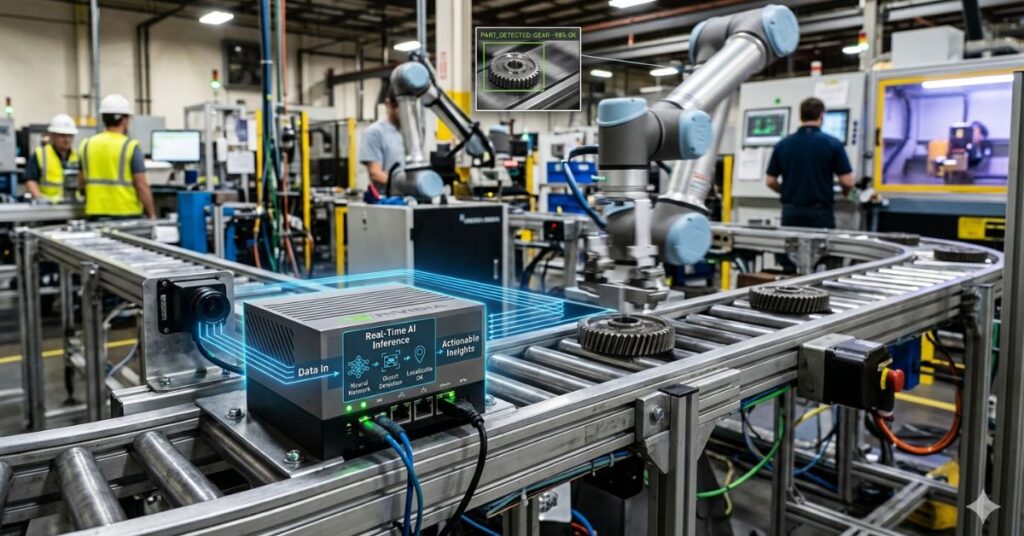
Edge AI systems process images and video directly on local hardware, converting captured data into instant decisions within milliseconds.
AI Models, Sensors, and Embedded Hardware
Every embedded computer vision system starts with sensors and cameras. These devices collect visual information from the environment.
The edge device then runs optimized deep learning models for tasks such as:
- Object detection
- Facial recognition
- Image classification
- Motion tracking
- Defect inspection
Developers usually optimize models using TensorFlow Lite for edge devices or OpenVINO toolkits.
Real-Time Data Processing and Low Latency
Edge vision processing reduces delays and enables near-instant responses in critical applications. In many industries, even a one-second delay can create serious problems.
For example:
- Self-driving vehicles need instant object detection
- Security systems require real-time threat alerts
- Industrial robots depend on rapid visual feedback
Edge systems reduce latency because the device processes data locally instead of sending it across the internet.
On-Device Inference Explained
On-device AI processing indicates that the model operates directly on the hardware itself. The workflow usually looks like this:
- The camera captures data
- AI model analyzes frames
- Device generates predictions
- System triggers actions immediately
This process improves privacy because the system does not upload sensitive video streams to external servers.
Common Edge AI Frameworks and Tools
Several frameworks support edge deep learning models.
| Framework | Main Use |
| TensorFlow Lite | Lightweight AI deployment |
| Intel OpenVINO | CPU optimization |
| NVIDIA TensorRT | GPU acceleration |
| PyTorch Mobile | Mobile AI deployment |
| ONNX Runtime | Cross-platform inference |
These tools help developers optimize performance for embedded systems.
Top Real-World Applications of Edge Computer Vision
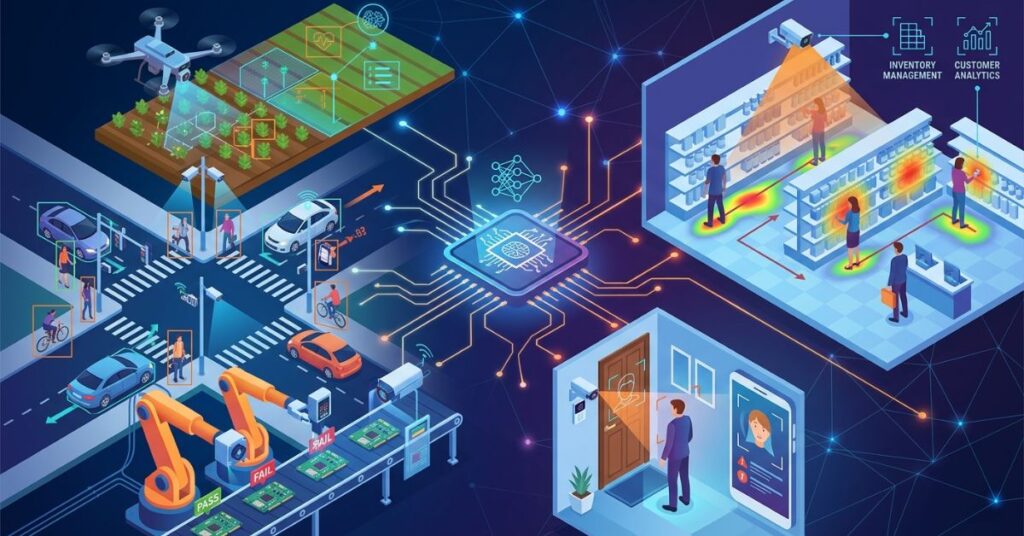
Edge vision applications are expanding rapidly across multiple industries.
Smart Manufacturing and Defect Detection
Manufacturers use AI-powered inspection systems to detect product defects instantly.
Edge cameras inspect:
- Surface scratches
- Missing components
- Packaging issues
- Assembly errors
Factories reduce waste and improve production speed through automated inspection systems.
A real-world deployment can improve inspection accuracy from 82% to 97% while reducing manual labor costs significantly.
Retail Analytics and Customer Tracking
Edge vision in retail analytics helps stores understand customer behavior in real time.
Stores use edge AI cameras for:
- Footfall tracking
- Queue monitoring
- Heatmap analysis
- Shelf inventory monitoring
Because the device processes data locally, retailers can protect customer privacy while still gathering valuable insights.
Autonomous Vehicles and Traffic Monitoring
Autonomous vehicle vision systems are significantly dependent on edge AI.
Vehicles must detect:
- Pedestrians
- Traffic signals
- Road markings
- Other vehicles
Traffic monitoring systems also use edge cameras to analyze congestion and improve traffic flow in smart cities.
Healthcare and Medical Imaging
Healthcare providers use edge computer vision for faster diagnostics and patient monitoring.
Hospitals deploy edge AI systems for:
- Medical image analysis
- Patient movement detection
- Surgical assistance
- Smart monitoring systems
Edge processing improves response times while protecting sensitive medical data.
Agriculture, Drones, and Smart Farming
Agricultural drones use embedded vision systems for crop analysis and field monitoring.
Farmers can detect:
- Plant diseases
- Soil issues
- Water stress
- Pest infestations
Edge AI enables drones to analyze data instantly without relying on cloud connectivity in remote areas.
Best Edge Computer Vision Hardware and Software Platforms
Choosing the right hardware matters because performance requirements vary across industries.
NVIDIA Jetson vs Raspberry Pi AI Kits
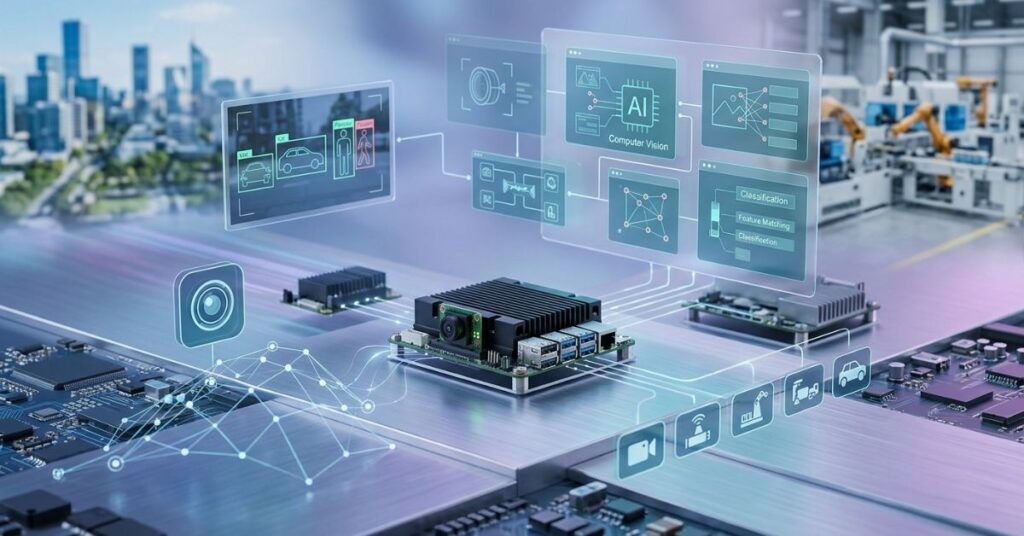
NVIDIA Jetson edge AI devices dominate high-performance deployments.
| Platform | Best For | Strength |
| NVIDIA Jetson Nano | Advanced AI workloads | GPU acceleration |
| Raspberry Pi AI Kit | Budget projects | Low cost |
| Jetson Xavier NX | Industrial AI | High FPS |
| Raspberry Pi 5 + AI HAT | Learning projects | Easy setup |
Jetson platforms handle complex AI inference more efficiently than Raspberry Pi systems.
Intel OpenVINO and Google Coral Explained
Intel OpenVINO toolkit optimizes AI models for Intel processors. It improves inference speed on CPUs and VPUs. Google Coral devices use Edge TPU accelerators for fast, low-power inference. These systems work well for lightweight object detection tasks.
TensorFlow Lite vs PyTorch Mobile
TensorFlow Lite emphasizes efficient deployment for embedded systems. Developers often use it for Android devices and IoT hardware.
PyTorch Mobile offers greater flexibility for research-focused workflows.
| Feature | TensorFlow Lite | PyTorch Mobile |
| Deployment Speed | Faster | Moderate |
| Ease of Optimization | Strong | Good |
| Research Flexibility | Moderate | Excellent |
| Embedded Support | Excellent | Good |
Choosing the Right Edge AI Stack
The right edge AI stack depends on several factors:
- Latency requirements
- Power limitations
- Budget
- Model complexity
- Deployment scale
A retail store may only need lightweight object detection, while an autonomous vehicle requires advanced multi-camera AI processing.
Recommended: Computer Vision Retail Trends | AI-Powered Smart Stores 2026
Benefits, Challenges, and ROI of Edge Vision Systems
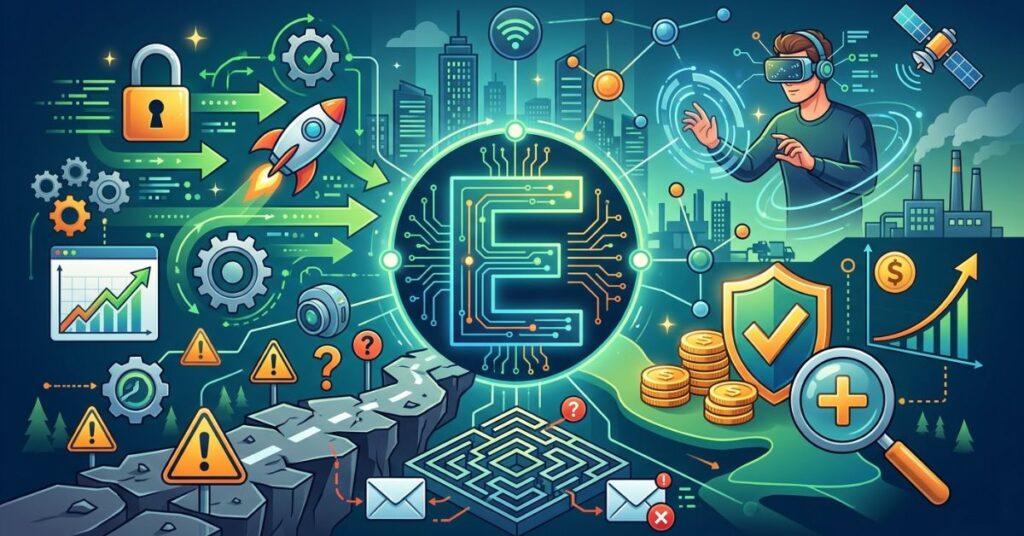
Edge AI delivers strong business benefits, but deployment still comes with challenges.
Faster Processing and Reduced Latency
Low-latency computer vision allows systems to respond instantly.
Real-time processing helps businesses:
- Improve safety
- Increase automation speed
- Reduce downtime
- Enhance customer experiences
Privacy and Security Advantages
Edge AI retains sensitive information on local devices. This method minimizes exposure risks as it prevents companies from transferring substantial video datasets to external cloud servers. Industries such as healthcare and finance benefit greatly from local AI inference.
Power Consumption and Scalability Challenges
Embedded systems often face hardware limitations.
Challenges include:
- Limited memory
- Heat generation
- Battery constraints
- Device management complexity
Developers must optimize edge deep learning models carefully to maintain efficiency.
Cost Savings and Automation ROI
Businesses often recover deployment costs quickly through automation.
| Benefit | Business Impact |
| Automated inspections | Lower labor costs |
| Faster decisions | Higher productivity |
| Reduced downtime | Improved efficiency |
| Local processing | Lower cloud expenses |
Many manufacturing companies recover their investment within 12–18 months.
Common Mistakes Businesses Make
Companies often struggle because they:
- Choose oversized AI models
- Ignore hardware limitations
- Skip real-world testing
- Underestimate deployment complexity
Successful projects start with clear performance goals and realistic scalability planning.
Step-by-Step Guide to Building an Edge Computer Vision System
Developers follow a structured process when building edge AI systems.
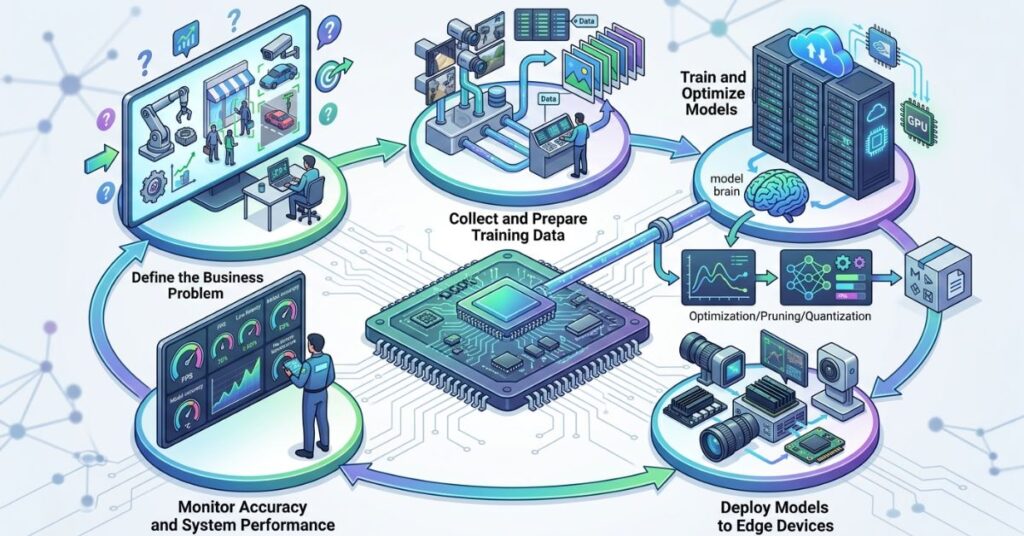
Define the Business Problem
Start with a specific use case.
For example:
- Detect defective products
- Count customers entering a store
- Monitor traffic intersections
Clear goals simplify hardware and model selection.
Collect and Prepare Training Data
Data quality directly impacts AI performance.
Developers should collect:
- Diverse lighting conditions
- Different object angles
- Real-world operating scenarios
Good datasets improve accuracy dramatically.
Train and Optimize AI Models
Training usually happens on powerful cloud GPUs or local workstations.
After training, developers optimize models using:
- Quantization
- Pruning
- TensorRT acceleration
- OpenVINO optimization
These techniques minimize the size of the model and enhance the speed of inference.
Deploy Models to Edge Devices
Deployment includes:
- Installing runtime frameworks
- Loading optimized models
- Configuring camera inputs
- Running inference pipelines
Testing under real-world conditions remains critical during this stage.
Monitor Accuracy and System Performance
Deployment does not end after installation.
Teams should continuously monitor:
- FPS performance
- Inference latency
- Accuracy rates
- Hardware temperatures
Regular updates help maintain long-term reliability.
Real Case Studies and Performance Benchmarks
Real-world deployments help businesses understand practical edge AI performance.
Manufacturing Quality Inspection Example
A manufacturing company deployed industrial edge vision systems on an assembly line.
The setup included:
- NVIDIA Jetson Xavier NX
- High-speed industrial cameras
- TensorRT optimized defect detection models
Results after deployment:
| Metric | Before AI | After Edge AI |
| Inspection Accuracy | 82% | 97% |
| Manual Labor Hours | High | Reduced by 60% |
| Product Defects | Frequent | Reduced significantly |
| Inspection Speed | Slow | Real-time |
Smart Surveillance Deployment Results
A smart surveillance with edge AI project improved security operations in a commercial building.
The system detected:
- Unauthorized access
- Suspicious movement
- Crowd congestion
Because the system processed data locally, the organization improved privacy compliance while reducing cloud storage costs.
Retail Footfall Analytics Case Study
A retail chain deployed edge AI cameras across multiple stores.
The project delivered:
- Real-time customer counts
- Queue analysis
- Product interaction tracking
Managers utilized the insights to enhance store layouts and optimize staffing efficiency.
Benchmark Results Across Edge Devices
The following benchmark illustrates typical edge AI performance comparisons.
| Device | FPS | Power Usage | Latency | Accuracy |
| NVIDIA Jetson Nano | 24 FPS | Moderate | Low | High |
| Raspberry Pi AI Kit | 10 FPS | Low | Moderate | Moderate |
| Intel Movidius | 18 FPS | Low | Low | High |
| Jetson Xavier NX | 60 FPS | Higher | Very Low | Excellent |
These benchmarks vary depending on model complexity and camera resolution.
The Future of Edge Computer Vision
Edge AI is evolving rapidly as hardware becomes more powerful and efficient.
TinyML and Ultra-Light AI Models
TinyML focuses on running AI models on extremely small devices.
These systems enable:
- Wearable AI
- Smart sensors
- Battery-powered IoT devices
TinyML is expected to greatly enhance the adoption of edge AI in the coming years.
5G-Powered Edge AI Applications
5G networks improve edge AI connectivity and scalability.
Faster communication enables:
- Smarter autonomous systems
- Connected factories
- Real-time remote monitoring
5G and edge AI together will transform industrial automation.
Generative AI at the Edge
Developers are now experimenting with generative AI on embedded systems.
Future edge devices may support:
- Local AI assistants
- Real-time content generation
- Smart robotics communication
Hardware optimization is expected to be a key factor in this transition.
Emerging Trends in Embedded Vision
Several trends continue shaping the industry:
- Energy-efficient AI chips
- Multi-camera edge systems
- Federated learning
- AI model compression
- Edge-cloud hybrid architectures
Frequently Asked Questions
What industries use edge computer vision?
Manufacturing, healthcare, retail, agriculture, transportation, logistics, and security industries use edge computer vision extensively.
Is edge AI better than cloud AI?
Edge AI works better for low-latency and privacy-sensitive applications. Cloud AI still supports large-scale training and centralized analytics effectively.
Which hardware works best for edge vision?
NVIDIA Jetson devices work well for advanced AI workloads. Raspberry Pi AI kits fit lightweight and budget-friendly projects.
How much does an edge AI system cost?
Small deployments may cost a few hundred dollars, while enterprise-scale industrial systems can cost thousands, depending on hardware and infrastructure.
Can small businesses use edge computer vision?
Yes. Affordable edge AI cameras and embedded systems now allow small businesses to deploy automation and analytics solutions without massive budgets.
Conclusion
Edge computer vision is becoming a core technology in AI-driven automation across industries. Companies are increasingly utilizing edge AI systems to accelerate data processing, enhance security, and minimize reliance on cloud services. From smart factories to healthcare and retail, edge vision technology helps companies make quick and accurate decisions in real time. As hardware becomes more powerful and affordable, more industries will adopt edge AI solutions in the coming years.
If you want to start with edge computer vision, begin with a simple project and focus on solving a real problem. Choose the right hardware, optimize your AI models, and test performance carefully before scaling your system. Even small edge AI deployments can improve efficiency and save costs. With the right strategy, businesses and developers can build smarter and faster AI systems at the edge.
Related AI Articles: How Automation and Robotics Are Transforming Modern Business

Qasim Ali is a Lead AI Solutions Architect and the founder of TechyPulse, with over 12 years of experience in enterprise digital transformation. Holding an MSc in Computer Science, he specializes in making Artificial Intelligence, Cybersecurity, and Machine Learning accessible and scalable. Qasim is dedicated to decoding complex neural networks into actionable insights for the modern technical landscape.