
Introduction
Retailers face relentless pressure to reduce shrinkage, improve inventory accuracy, and deliver seamless shopping experiences. Meanwhile, customers expect speed, convenience, and privacy. Retail AI Vision Automation meets these demands head-on. It combines computer vision, edge computing, and intelligent analytics to transform how stores operate in real time.
In this guide, I walk you through how Computer Vision in Retail works, where it delivers measurable value, and how you can implement it without disrupting daily operations. I also share a real-world case study, a proprietary rollout framework, and practical insights you won’t find in generic AI overviews.
What Is Retail AI Vision Automation?
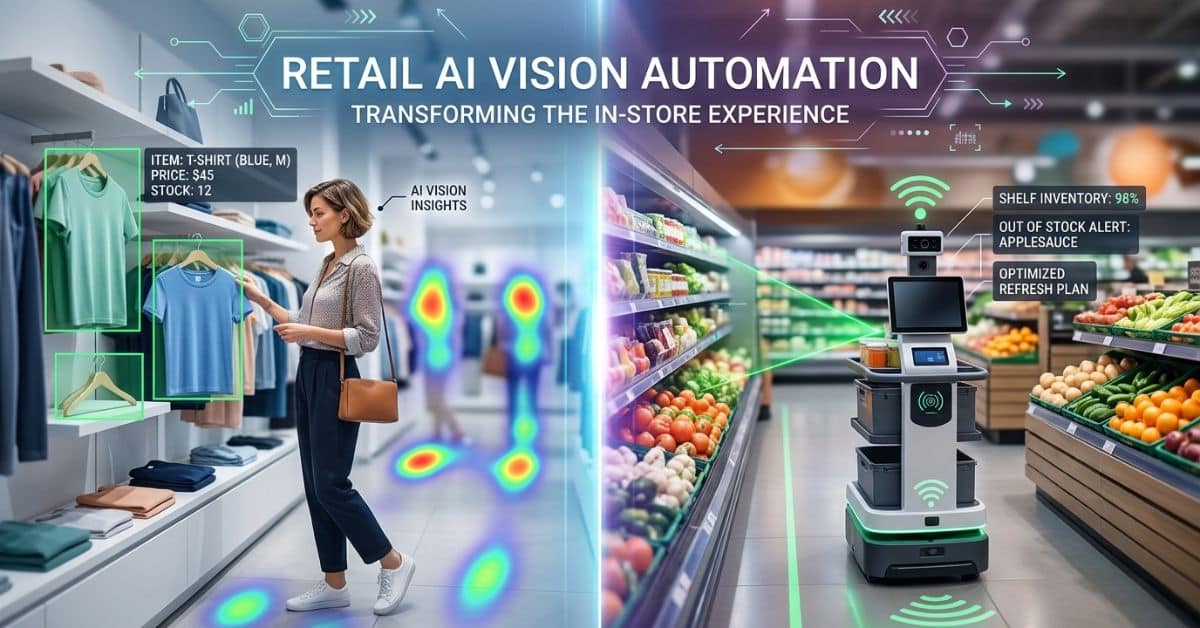
Retail AI Vision Automation uses cameras and AI models to analyze in-store activity in real time. Instead of relying on periodic manual checks, stores gain continuous visibility into inventory, shopper behavior, and operational events.
For example, Automated Visual Inspection for Stores can:
- Detect out-of-stock items instantly
- Monitor shelf compliance against planograms
- Identify suspicious behavior for loss prevention
- Track customer movement patterns through heatmaps
As a result, retailers move from reactive decision-making to proactive store management.
Core Technologies Powering AI Vision in Retail
Computer Vision and Object Detection
Modern systems rely on advanced object detection algorithms such as YOLO and ResNet. These models identify products, people, and actions with high accuracy.
However, raw detection alone does not solve retail challenges. You need context.
Edge Computing for Real-Time Processing
Edge computing processes video data locally within the store. This approach reduces latency, enhances privacy, and lowers bandwidth costs.
Additionally, edge systems enable real-time alerts, such as notifying staff when shelves go empty.
AI Models for Behavioral Understanding
Retail environments remain complex and dynamic. Therefore, systems must interpret behavior, not just objects.
For instance:
- A shopper picking up an item differs from a staff member restocking
- A lingering customer near a shelf signals interest, not theft
This leads us to a critical concept.
The “Signal vs. Noise” Methodology
Retail stores generate enormous volumes of visual data. However, not all data carries meaning. You must separate valuable signals from irrelevant noise.

How It Works
Instead of relying solely on static object detection, advanced systems use temporal analysis. They analyze how objects move and interact over time.
For example:
- A restocking event shows repeated placement of items in a structured pattern
- A browsing customer exhibits irregular movement and hesitation
By analyzing these patterns, the system distinguishes between operational activities and customer behavior.
Why It Matters
This approach:
- Reduces false alerts
- Improves accuracy in inventory tracking
- Enhances AI-powered loss prevention
Ultimately, it transforms raw video into actionable intelligence.
Key Use Cases Driving ROI
Real-Time Inventory Tracking
AI continuously monitors shelves and flags stockouts instantly. Therefore, staff can replenish items before customers notice gaps.
Shelf Monitoring AI and Planogram Compliance
Retailers maintain strict product placement strategies. AI ensures compliance by comparing live shelf images against planograms.
AI-Powered Loss Prevention
Vision systems detect unusual patterns, such as concealed items or suspicious movement. However, they avoid invasive tracking by focusing on behavior rather than identity.
Heatmap Analytics for Retailers
Heatmaps reveal where customers spend time. As a result, retailers can optimize product placement and store layout.
Autonomous Checkout Systems
AI enables frictionless shopping experiences by eliminating traditional checkout lines. Customers simply pick items and leave.
Queue Management AI
AI predicts queue buildup and alerts staff to open additional counters, improving customer satisfaction.
Case Study: Achieving a 15% Shrinkage Reduction
Let’s examine a real-world deployment in a mid-sized grocery chain.
Baseline
- Manual inventory audits are performed every 48 hours
- Frequent stock discrepancies
- High levels of “phantom inventory.”
Intervention
The retailer deployed ceiling-mounted edge vision nodes across key aisles. These nodes enabled continuous monitoring and real-time alerts.
Outcome
- Stockout alerts reduced phantom inventory by 22% within 90 days
- Overall, shrinkage dropped by 15%
- Staff productivity improved due to fewer manual audits
Key Insight
The system did not just detect missing items. It identified patterns that caused inventory errors, allowing the retailer to fix root problems.
Recommended: Retail AI Vision Innovation: How Smart Stores Cut Losses Fast
Traditional Sensors vs AI Vision
| Feature | Standard Motion Sensors | AI Vision Systems |
| Accuracy | Low | High |
| Data Depth | Binary (motion/no motion) | Rich contextual insights |
| Installation Cost | Low | Moderate |
| Scalability | Limited | High |
| Real-Time Insights | No | Yes |
| Behavioral Understanding | None | Advanced |
Clearly, AI vision offers significantly greater value despite higher upfront investment.
Proprietary Implementation Roadmap: The 5-Stage Pilot
Scaling AI vision requires a structured approach. I recommend the following five-stage framework.
Phase 1: Lighting and Occlusion Assessment
Evaluate store lighting conditions and identify visual obstructions. Poor lighting can degrade model accuracy.
Phase 2: Edge-to-Cloud Latency Stress Testing
Test system performance under real-world conditions. Ensure that data flows efficiently between edge devices and cloud systems.
Phase 3: Synthetic Data Augmentation
Use synthetic data to train models on rare or niche SKUs. This improves detection accuracy without requiring extensive manual labeling.
Phase 4: Associate Workflow Integration
Integrate AI alerts into staff workflows. For example, send restocking alerts directly to handheld devices.
Phase 5: Full-Scale Automated Reconciliation
Enable end-to-end automation where inventory updates occur automatically based on visual data.
Cost-Benefit Analysis of Retail Vision Systems
Retailers often ask: Does the investment justify the cost?
Key Costs
- Hardware (cameras, edge processors)
- Software licensing
- Integration and deployment
Key Benefits
- Reduced shrinkage
- Improved inventory accuracy
- Lower labor costs
- Increased sales from better availability
ROI Drivers
The strongest ROI typically comes from:
- Stockout reduction strategies
- Loss prevention improvements
- Labor optimization
Most retailers achieve payback within 12–24 months, depending on scale.

Privacy-First Retail Video Analytics
Privacy concerns remain a top priority. Therefore, modern systems adopt privacy-first principles.
Key Practices
- Facial blurring at the edge
- No storage of personally identifiable information
- Focus on behavior, not identity
As a result, retailers can leverage AI while maintaining customer trust.
Enhancing the Customer Experience
AI vision does not just improve operations—it enhances shopping experiences.
Frictionless Shopping
Customers enjoy faster, checkout-free experiences.
Smart Mirror Technology
Retailers use smart mirrors to recommend products and personalize experiences.
Improved Store Layouts
Heatmap insights help retailers design intuitive store layouts.
Ultimately, these improvements increase customer satisfaction and loyalty.
Multimedia Integration for Better Understanding
To fully grasp AI vision systems, visual aids are crucial.
System Architecture Diagram
A typical system includes:
- Camera input
- Edge processing unit
- Cloud analytics platform
- Mobile dashboard for store managers
Annotated Video Walkthrough
A short video can demonstrate how AI tracks items using bounding boxes while maintaining privacy by blurring faces.
Interactive ROI Calculator
Retailers can input:
- Store count
- Labor cost
- Shrinkage rate
The tool then estimates ROI and payback period.
Challenges and How to Overcome Them
Data Quality Issues
Poor lighting or cluttered shelves can affect accuracy. Therefore, conduct thorough environmental assessments.
Integration Complexity
Legacy systems may require customization. However, phased implementation reduces risk.
Staff Adoption
Employees may resist new technology. Training and clear communication help drive adoption.
FAQs
How do I implement AI vision in brick-and-mortar stores?
Start with a pilot in a single aisle. Then expand gradually using a structured roadmap. Focus on measurable outcomes such as stock accuracy and shrinkage reduction.
What makes AI vision better than traditional inventory systems?
AI provides real-time insights instead of periodic snapshots. Additionally, it captures behavioral context, which traditional systems cannot.
Is AI vision expensive to deploy?
Initial costs can be moderate. However, strong ROI from reduced shrinkage and improved efficiency offsets the investment.
How does AI protect customer privacy?
Systems use anonymization techniques such as facial blurring and avoid storing personal data.
Can small retailers use AI vision?
Yes. Scalable solutions allow smaller stores to adopt AI incrementally.
Conclusion: The Future of Retail Starts Now
Retail AI Vision Automation represents a fundamental shift in how stores operate. It replaces guesswork with real-time intelligence, manual processes with automation, and reactive decisions with proactive strategies.
However, success depends on execution. Retailers must focus on data quality, workflow integration, and phased deployment. When done correctly, AI vision delivers measurable results—from reduced shrinkage to improved customer experiences.
Ultimately, retailers who embrace this technology today will lead the industry tomorrow.

Qasim Ali is a Lead AI Solutions Architect and the founder of TechyPulse, with over 12 years of experience in enterprise digital transformation. Holding an MSc in Computer Science, he specializes in making Artificial Intelligence, Cybersecurity, and Machine Learning accessible and scalable. Qasim is dedicated to decoding complex neural networks into actionable insights for the modern technical landscape.