

Introduction
Most businesses in 2026 are not struggling with AI tools. They are struggling with failed AI adoption. In fact, many companies have already invested in generative AI, but most of those projects never go beyond pilot stages or deliver real ROI.
The reason is simple: they don’t have the right guidance, strategy, and technical direction.
That is where Generative AI consulting services come in. These services help businesses plan, build, and scale AI solutions in a structured and safe way.
In this guide, we will break down the 7 most important consulting services every business needs in 2026 to successfully adopt generative AI and stay ahead of competitors.
What Are Generative AI Consulting Services?
Generative AI consulting services help businesses plan, build, and deploy AI solutions powered by large language models (LLMs) and related technologies. Consultants bring technical depth, strategic experience, and implementation know-how that most enterprises haven’t had time to build internally.
The scope runs wider than most people expect. It’s not just about plugging in ChatGPT. It covers everything from assessing whether your data is AI-ready, to selecting the right model, to building custom applications, to setting up the governance policies that keep regulators happy.
How AI Consultants Differ from Traditional IT Consultants
Traditional IT consultants optimize what already exists: ERP implementations, cloud migrations, security audits. Generative AI consultants work at a different layer. They translate business problems into AI architectures, evaluate cutting-edge models from providers like OpenAI, Anthropic, Google, and Meta, and make judgment calls that require hands-on experience with systems that didn’t exist two years ago.
The distinction matters because the wrong hire wastes both time and money. A great systems integrator won’t automatically know how to design a RAG pipeline or evaluate hallucination risks in a customer-facing chatbot.
Services Included in a Generative AI Engagement
A full-scope engagement typically covers:
- Strategy: Defining where AI creates the most value for your specific business
- Discovery: Mapping existing workflows, data assets, and infrastructure
- Use-case identification: Ranking opportunities by impact, feasibility, and risk
- Model selection: Choosing between foundation models, fine-tuned models, or custom builds
- Development: Building and testing the actual AI application
- Governance: Creating policies around data use, output review, and compliance
- Training: Getting your teams comfortable using and managing the new systems
Why Businesses Hire Generative AI Consultants

Lack of Internal Expertise
Most enterprise teams have solid software engineers and data analysts. What they rarely have is someone who has actually shipped a production-grade LLM application, debugged hallucination issues at scale, or built a retrieval-augmented generation system from scratch. That gap is the primary reason companies bring in outside consultants.
Faster Time-to-Value
Consultants compress timelines because they’ve already made the expensive mistakes on someone else’s project. They know which model performs best for contract analysis, which vector database handles enterprise-scale queries efficiently, and which deployment patterns avoid the most common failure modes. That accumulated knowledge translates directly into faster delivery.
Reduced Project Risk
Generative AI projects carry real risk: model outputs can be wrong, biased, or inappropriate. Data pipelines can leak sensitive information. Systems can fail under production load. Experienced consultants build mitigation into the architecture from day one rather than bolting it on after something goes wrong.
Regulatory and Compliance Requirements
Healthcare, financial services, and legal firms operate under strict data regulations. A consultant who understands HIPAA, SOC 2, GDPR, and emerging AI governance frameworks like the EU AI Act saves companies from compliance violations that can dwarf the cost of the consulting engagement itself.
Enterprise Change Management
Technology rarely fails because of bad code. It fails because people don’t adopt it. Senior AI consultants bring change management experience; they know how to run workshops, address employee concerns, and design rollouts that actually stick.
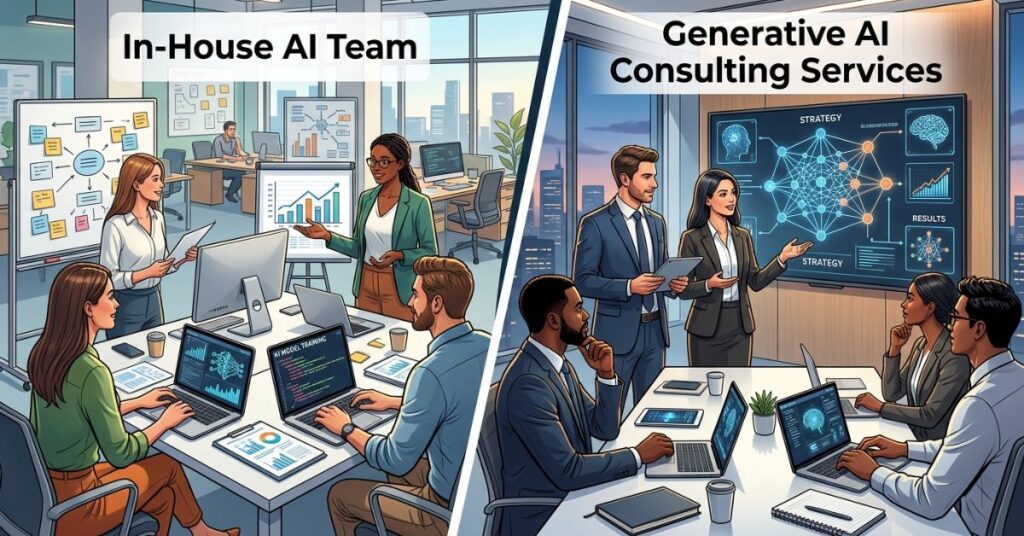
In-House AI Team vs Generative AI Consulting Services
| Factor | In-House Team | AI Consulting Firm |
| Deployment Speed | Slower | Faster |
| AI Expertise | Limited | Specialized |
| Project Risk | Higher | Lower |
| Upfront Investment | Higher | Lower |
| Governance Knowledge | Varies | Established Frameworks |
| Time to ROI | Longer | Shorter |
For many organizations, consultants help accelerate deployment while reducing costly implementation mistakes.
Types of Generative AI Consulting Services
AI Readiness Assessments
Before building anything, smart companies want to know where they actually stand. A readiness assessment evaluates your data quality, infrastructure, organizational culture, and governance posture. It tells you what’s ready to go and what needs fixing first.
AI Strategy Development
Strategy consulting produces a clear roadmap: which use cases to pursue, in what order, with what resources, and against what success metrics. It connects AI initiatives to board-level business objectives rather than letting them drift into IT project territory.
Proof of Concept (PoC) Consulting
A PoC is a contained, time-boxed experiment designed to answer one question: does this actually work for our specific problem? Good PoC consulting keeps scope tight, moves fast, and generates the evidence needed to justify full-scale investment.
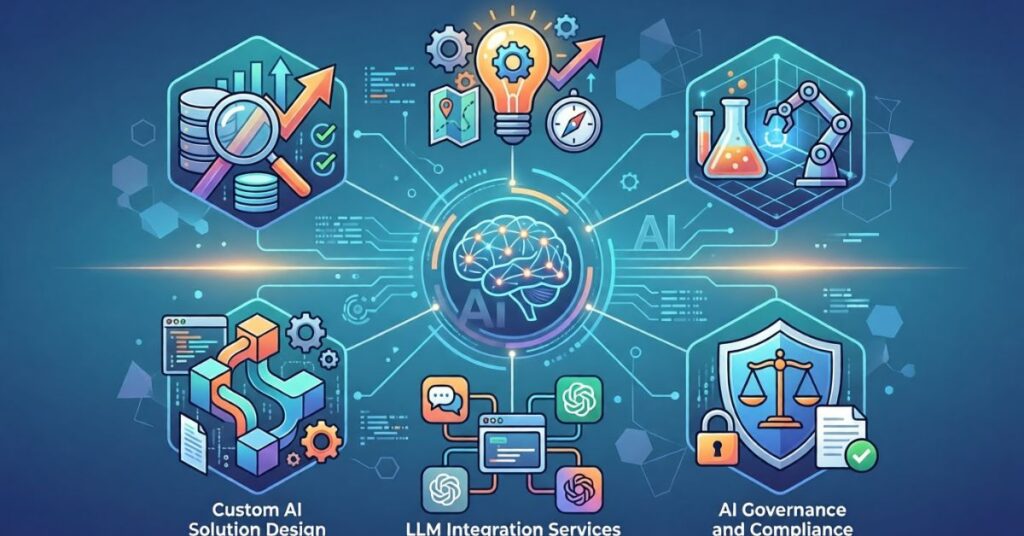
Custom AI Solution Design
When off-the-shelf tools don’t fit, consultants design custom solutions purpose-built applications that integrate with existing systems, follow company-specific workflows, and meet enterprise security requirements.
LLM Integration Services
Most enterprises don’t build their own foundation models. They integrate existing ones: OpenAI’s GPT models, Anthropic’s Claude, Google Gemini, or open-source options like Meta’s Llama. Integration consulting covers API architecture, prompt engineering, output validation, and performance optimization.
AI Governance and Compliance
Governance consulting establishes the policies, workflows, and technical controls that keep AI systems operating responsibly. This includes output review processes, bias testing, audit trails, and compliance documentation.
Workforce Enablement and Training
Technology without adoption is just expensive shelfware. Workforce enablement programs train employees to use AI tools effectively, address common misconceptions, and build internal champions who sustain adoption over time.
The Generative AI Consulting Process Explained
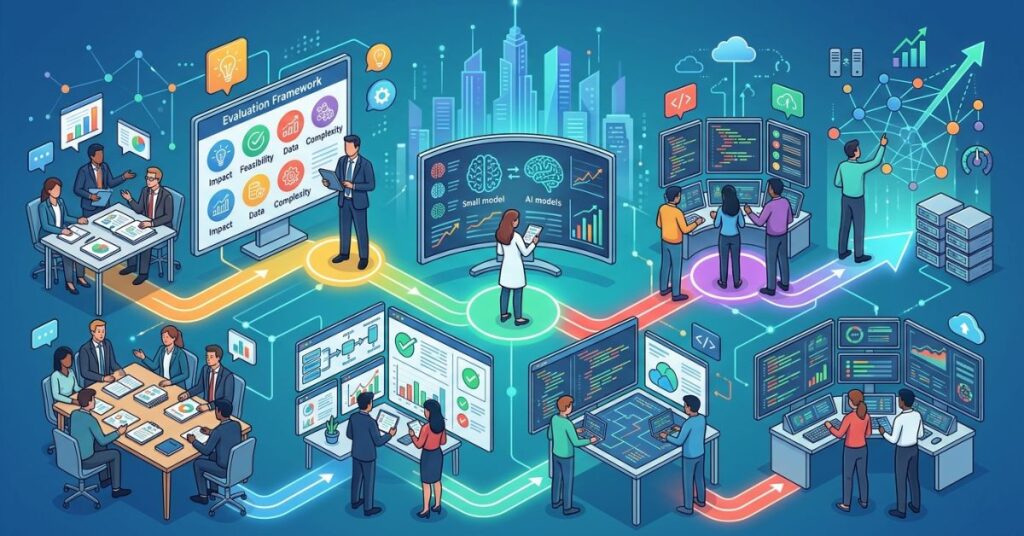
Phase 1: Business Discovery
Consultants start by understanding the business, not the technology. They interview stakeholders, map current workflows, identify pain points, and define success in business terms. This phase sets the direction for everything that follows.
Phase 2: Opportunity Assessment
With business context in hand, consultants evaluate potential AI use cases against a consistent framework: expected impact, technical feasibility, data availability, regulatory constraints, and implementation complexity. The output is a prioritized list of opportunities.
Phase 3: Data Evaluation
AI systems are only as good as the data that feeds them. Data evaluation examines quality, completeness, structure, and compliance status. It identifies gaps that need addressing before development begins.
Phase 4: Model Selection
Not every problem needs GPT-4. Consultants select models based on task requirements, latency needs, cost constraints, data privacy rules, and performance benchmarks. Sometimes a smaller, fine-tuned model outperforms a general-purpose large model for a specific use case.
Phase 5: Development and Integration
This is where the application gets built, pipelines are designed, APIs connected, interfaces developed, and integrations tested with existing enterprise systems. Good development also includes robust evaluation frameworks to catch errors before deployment.
Phase 6: Deployment
Deployment moves the system from a controlled environment into production. It includes performance testing, security review, user acceptance testing, and staged rollout strategies that minimize disruption.
Phase 7: Optimization and Scaling
Post-deployment work is where many projects underinvest. Optimization improves accuracy, reduces latency, lowers cost, and fixes issues that only surface under real production conditions. Scaling extends the system to additional use cases, teams, or business units.
Recommended: Generative AI for Research: Smarter Academic Workflows Guide
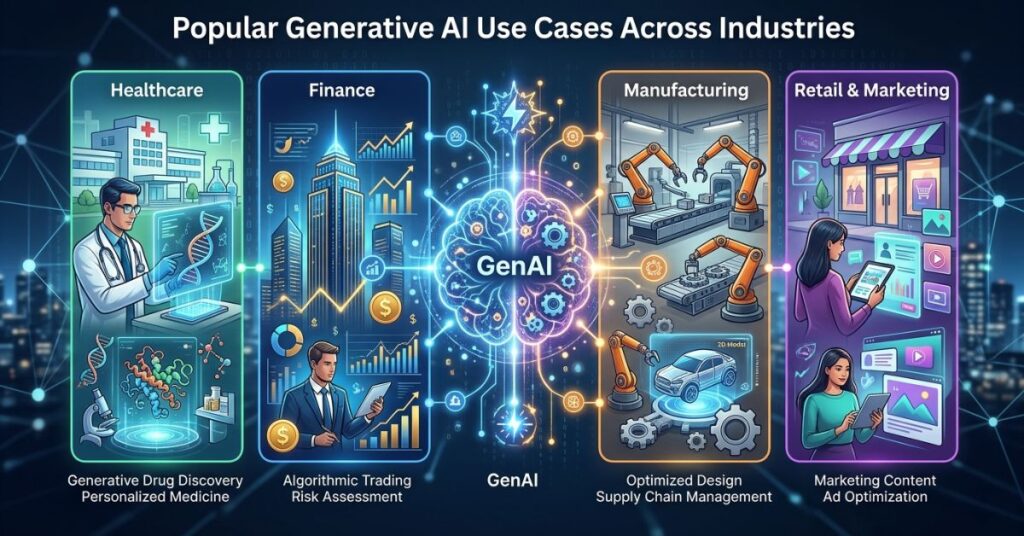
Popular Generative AI Use Cases Across Industries
| Industry | Use Case | Business Impact |
| Healthcare | Clinical documentation automation | Reduces physician admin time by 30–50% |
| Healthcare | Patient engagement chatbots | Improves response times and satisfaction scores |
| Financial Services | Automated risk analysis reports | Cuts analyst preparation time significantly |
| Financial Services | AI-powered customer support | Handles tier-1 queries without agent involvement |
| Retail | Personalized product recommendations | Increases average order value and conversion rates |
| Retail | Dynamic marketing content generation | Reduces content production costs |
| Manufacturing | Internal knowledge management systems | Speeds up employee onboarding and troubleshooting |
| Manufacturing | Process documentation automation | Standardizes SOPs across facilities |
| Legal Services | Contract review and summarization | Cuts review time from hours to minutes |
| Legal Services | Legal research assistance | Accelerates case preparation |
| SaaS & Technology | AI copilots for internal teams | Boosts developer and support productivity |
| SaaS & Technology | Customer support automation | Deflects high volumes of repetitive tickets |
How to Build a Successful Generative AI Strategy
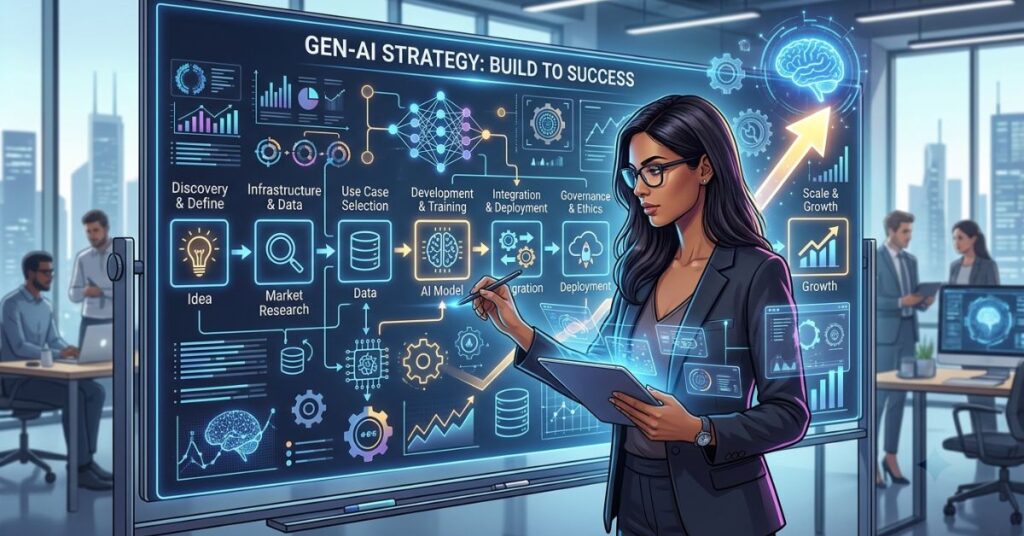
Define Business Objectives
AI strategy that doesn’t connect to board-level priorities dies in the pilot stage. Start by identifying the two or three business outcomes that matter most: cost reduction, revenue growth, customer experience, employee productivity, and work backward to identify where AI can move those metrics.
Prioritize High-Impact Use Cases
Every company has a long list of AI ideas. The ones worth pursuing score high on all three dimensions: meaningful business impact, available and clean data, and manageable implementation complexity. Don’t start with the most exciting idea; start with the one most likely to succeed and prove the model.
Assess Data Readiness
You can’t build reliable AI on unreliable data. Assess the quality, completeness, and governance status of the data you plan to use. Fix the most critical gaps before development begins, not after.
Establish Governance Policies
Define how the organization approves AI use cases, reviews model outputs, handles errors, and manages sensitive data. Governance frameworks built early are far less painful than ones retrofitted after a compliance incident.
Create Adoption Plans
Identify the teams that will use each AI system, understand their concerns, and design adoption programs that address those concerns directly. Involve end users early. People adopt tools they helped shape.
Measure Success Metrics
Define success before you build anything. Agree on the metrics, the measurement methodology, and the benchmarks. This creates accountability and gives you the evidence base to expand investment when results come in.
Choosing the Right Generative AI Consulting Company

Technical Expertise Evaluation
Ask to see production systems they’ve built not demos, not slides. Probe their experience with model fine-tuning, RAG architectures, vector databases, and enterprise-grade deployment. The difference between a firm that has shipped production AI and one that has only run workshops is enormous.
Industry Experience Assessment
A consultant who has navigated HIPAA for a healthcare client will save a hospital system months of back-and-forth. Industry experience shortens timelines and reduces the risk of compliance surprises.
Security and Compliance Capabilities
Ask specifically how they handle data privacy during development and deployment. Understand their approach to model output auditing, access controls, and data residency requirements.
AI Governance Knowledge
Governance is no longer optional. Ask how they structure governance frameworks and what experience they have with the EU AI Act, NIST AI RMF, and industry-specific regulations.
Delivery Methodology
Understand how they run projects: sprint cycles, milestone reviews, escalation paths, and communication rhythms. A technically brilliant firm that communicates poorly will still drain your team’s time and patience.
Questions to Ask Before Hiring
Use this checklist during vendor evaluation:
- Can you show us a production AI system you built in our industry?
- How do you handle data privacy during model development and testing?
- What does your governance framework look like for regulated industries?
- How do you measure and report on AI system performance post-deployment?
- What’s your escalation process when a model underperforms in production?
- How do you approach change management and end-user adoption?
- What models do you work with, and how do you make model selection decisions?
- What does your post-deployment support and optimization service look like?
Examples of Leading Generative AI Consulting Companies
Several global consulting firms offer enterprise-grade generative AI consulting services, including Accenture, Deloitte, IBM Consulting, PwC, and Capgemini.
While capabilities vary, organizations should evaluate providers based on technical expertise, governance capabilities, industry experience, and proven production deployments.
Generative AI Technology Stack Explained
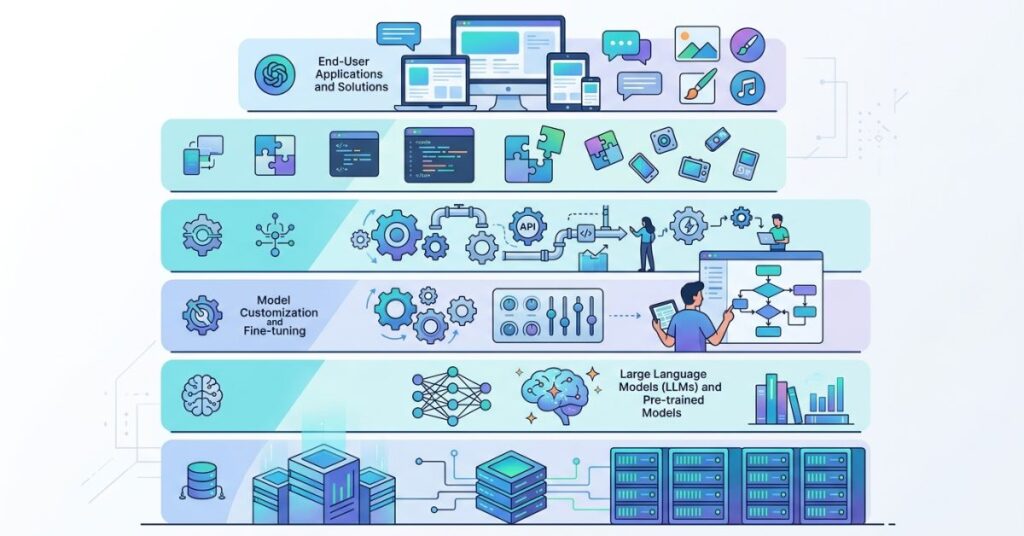
Foundation Models
Foundation models ChatGPT, Claude, Gemini, and Llama form the core intelligence layer. They handle language understanding, generation, and reasoning. The right choice depends on task requirements, latency budgets, privacy constraints, and cost.
Fine-Tuning Approaches
Fine-tuning adapts a general foundation model to a specific domain or task using company-specific data. It improves accuracy and consistency for specialized applications. Approaches range from full fine-tuning to parameter-efficient methods such as LoRA, which significantly reduce computational requirements.
RAG Architectures
Retrieval-Augmented Generation connects a language model to a company’s proprietary knowledge base. Instead of relying solely on what the model learned during training, RAG retrieves relevant documents at query time and passes them to the model as context. This dramatically improves accuracy for domain-specific questions and keeps responses grounded in current, company-specific information.
Vector Databases
Vector databases store information as numerical embeddings, enabling semantic search that finds conceptually relevant content even when exact keywords don’t match. Leading options include Pinecone, Weaviate, Qdrant, and pgvector for PostgreSQL-based deployments.
AI Infrastructure
Production AI systems require infrastructure for model serving, API management, monitoring, and scaling. Most enterprise deployments run on major cloud providers Microsoft Azure AI, Amazon Bedrock, or Google Cloud Vertex AI often combined with containerized deployment frameworks.
Monitoring and Observability
Production AI systems need continuous monitoring for output quality, latency, cost, and safety. Observability platforms track performance over time, alert on regressions, and provide the audit trails that compliance teams require.
Common Challenges and Risks
Hallucinations
Language models sometimes generate confident-sounding but factually wrong outputs. Mitigations include RAG architectures that ground responses in source documents, output validation layers, human review workflows for high-stakes decisions, and clear communication to end users about AI limitations.
Data Privacy Concerns
Training and testing AI systems with enterprise data creates real privacy exposure if not handled carefully. Proper data handling practices, such as anonymization, access controls, data residency management, and vendor data processing agreements, protect against both regulatory violations and reputational damage.
Intellectual Property Risks
AI systems trained on or generating content raise complex IP questions that courts are still resolving. Legal review of training data sources, output policies, and vendor agreements reduces exposure.
Bias and Fairness
Models trained on biased data produce biased outputs. Regular bias testing, diverse evaluation datasets, and human review of high-stakes decisions help identify and address fairness issues before they become public problems.
Regulatory Compliance
The regulatory landscape is moving quickly. The EU AI Act classifies AI systems by risk level with corresponding requirements. Healthcare and financial services carry industry-specific obligations. Compliance review at the architecture stage is far cheaper than retrofitting later.
Organizational Resistance
Employees worry AI will eliminate their jobs. That fear, whether valid or not, drives active and passive resistance to adoption. Transparent communication about how AI will change roles rather than eliminate them, combined with genuine involvement in design decisions, significantly improves adoption rates.
Measuring ROI from Generative AI Initiatives

Operational Efficiency Metrics
Track time saved on specific tasks, error rates before and after AI implementation, and throughput improvements. Operational efficiency metrics are usually the easiest to quantify and make the most compelling initial business case.
Cost Reduction Metrics
Measure direct cost savings: reduced labor hours on automatable tasks, lower customer support costs, reduced content production spend. Compare against total implementation and operational costs to calculate net savings.
Revenue Growth Metrics
Track conversion rate improvements from personalization, cross-sell and upsell revenue from AI recommendations, and new revenue from AI-enabled products or services.
Employee Productivity Metrics
Measure output per employee before and after AI deployment. Track time redirected from low-value to high-value work. Survey employees on perceived productivity impact.
Customer Experience Metrics
Monitor response time improvements, customer satisfaction scores, resolution rates, and Net Promoter Score changes. Customer experience improvements often drive revenue outcomes that justify significant AI investment.
Generative AI Consulting Costs and Pricing Models
Assessment Projects
AI readiness assessments typically range from $15,000 to $50,000 depending on scope and organizational complexity. They take two to six weeks and deliver a prioritized roadmap.
Proof-of-Concept Pricing
PoC projects typically run $30,000 to $150,000 for a six to twelve-week engagement. Cost depends on technical complexity, data preparation requirements, and the number of use cases being evaluated.
Enterprise Transformation Programs
Full enterprise AI transformation programs range from $200,000 to several million dollars, delivered over six to eighteen months. These programs cover strategy, multiple use cases, governance, and change management.
Managed AI Services
Ongoing managed services monitoring, optimization, model updates, and support typically run $10,000 to $50,000 per month depending on system complexity and service level requirements.
Factors Affecting Cost
| Factor | Impact on Cost |
| Number of use cases | High: each use case adds development and integration work |
| Data quality and readiness | High: poor data requires significant preparation investment |
| Regulatory complexity | Medium-High: compliance requirements add architecture and documentation work |
| System integration complexity | Medium-High: connecting to legacy systems adds significant effort |
| Model customization needs | Medium: fine-tuning adds cost beyond standard API integration |
| Geographic scope | Medium: multi-region deployments add infrastructure complexity |
| Internal team capacity | Medium: low internal support increases consultant time requirements |
Future Trends in Generative AI Consulting
Agentic AI
The next major shift moves from AI that answers questions to AI that takes actions. Agentic systems plan multi-step workflows, use tools, call APIs, and complete complex tasks with minimal human intervention. Consulting practices are rapidly building expertise in agent design, orchestration frameworks, and the new governance challenges autonomous systems create.
Multimodal Systems
Early enterprise AI focused almost entirely on text. Multimodal systems handle text, images, audio, and video together. This opens new use cases in quality inspection, document processing, customer service, and training anywhere that information comes in mixed formats.
AI Governance Evolution
Regulatory frameworks are maturing quickly. Consulting firms that build deep governance expertise will command premium positions as enterprises face mandatory compliance requirements across multiple jurisdictions.
Industry-Specific AI Models
General-purpose foundation models are giving way to purpose-built models trained on domain-specific data: medical records, legal documents, financial filings. These models outperform general models on specialized tasks and simplify compliance in regulated industries.
Autonomous Enterprise Workflows
Within the next two to three years, enterprises will run entire workflows autonomously from data ingestion through analysis to action, with human oversight at defined checkpoints rather than at every step. Consulting firms building expertise in autonomous workflow design, safety architecture, and governance will be well-positioned for this shift.
Conclusion
Most projects fail because teams skip proper planning and execution. Companies need clear direction, the right strategy, and strong technical support to make AI work in real business environments. Without that, AI stays stuck in pilot mode and never delivers real value.
This is where Generative AI Consulting Services make a real difference. They help companies move step by step, from planning to deployment, while reducing risk and improving results.
Businesses that follow a structured approach can scale AI faster, improve productivity, and stay ahead of competitors in a fast-changing market.
Frequently Asked Questions
What does a generative AI consultant do?
A generative AI consultant helps businesses identify AI opportunities, design technical solutions, select and configure models, build production applications, establish governance frameworks, and train teams to use and manage new AI systems effectively.
How much do generative AI consulting services cost?
Costs range from $15,000 for a focused readiness assessment to several million dollars for an enterprise transformation program. Most mid-market companies budget $100,000 to $500,000 for an initial strategy and implementation engagement.
How long does a generative AI implementation take?
A proof of concept typically takes six to twelve weeks. A production deployment of a single use case takes three to six months. Enterprise-scale transformation programs run twelve to eighteen months or longer.
How do I know if my company is ready for generative AI?
Your organization is ready to move when you have identifiable high-value use cases, reasonably clean data in those areas, executive support, and some organizational appetite for change. An AI readiness assessment provides a more precise picture.
What is RAG and why does it matter for enterprise AI?
RAG (Retrieval-Augmented Generation) is an AI architecture that connects models to your private data sources. It improves accuracy by using real company documents instead of only training data. This makes it essential for enterprise search, support, and knowledge systems.
How do companies reduce AI hallucination risks?
Effective mitigation combines RAG architectures that ground responses in source documents, output validation layers that check responses against known facts, confidence scoring, human review workflows for high-stakes decisions, and clear communication to users about AI limitations.
How do I measure the ROI of a generative AI project?
Define success metrics before the project starts. Track operational efficiency gains, cost reductions, revenue impacts, productivity improvements, and customer experience metrics. Compare measured outcomes against total implementation and operational costs.
Related AI Articles: AI Chatbot Development Services: Build Smart AI Assistants 2026

Qasim Ali is a Lead AI Solutions Architect and the founder of TechyPulse, with over 12 years of experience in enterprise digital transformation. Holding an MSc in Computer Science, he specializes in making Artificial Intelligence, Cybersecurity, and Machine Learning accessible and scalable. Qasim is dedicated to decoding complex neural networks into actionable insights for the modern technical landscape.