

Introduction
You sit down to name your Stand, and the cursor blinks at you for ten straight minutes. You want something that sounds like it belongs next to Star Platinum or King Crimson, not something that reads like a random word mashup from a generic fantasy name tool.
This gap between “sounds cool” and “sounds like it earned its place in the canon” is exactly why people look for AI-powered Stand naming tools instead of typing random words into a notes app.
An AI Stand Name Generator does something a traditional random-word tool can’t. It studies the patterns behind canonical JoJo naming patterns, including musical references, tarot symbolism, rhythm, and thematic cues.
Then it builds new names that follow those same rules. The best AI stand name maker tools don’t just spit out nouns. They understand that “Killer Queen” works because it’s a song title, a personality, and a threat all at once.
By the end, you’ll know why some Stand names feel instantly iconic while others sound forgettable, and you’ll have a repeatable method to create names that genuinely feel at home in the JoJo universe.
Why Traditional Name Generators Fail the “Stand” Test
Most online name generators run on the same basic trick: pull a random adjective, slap it next to a random noun, and call it a day. You end up with combinations like “Crimson Wolf” or “Shadow Fang,” names that sound fine for a video game character but completely miss what makes a Stand name work.

A specialized best anime stand name generator flips that approach. Instead of pulling from a flat word list, it pulls from curated thematic clusters, including musical genres, mythological figures, industrial terminology, and occult symbolism, then matches those themes to the tone you’re aiming for. That’s the difference between a name that sounds randomly assembled and one that sounds like it has a story behind it.
| Feature | Generic Random Generator | Specialized AI Stand Generator |
| Word source | Flat, unthemed word lists | Curated cultural/thematic clusters (music, tarot, mythology) |
| Context awareness | None; words are interchangeable | Matches name tone to ability type and user-defined theme |
| Syllable/rhythm logic | Ignored | Weighted for spoken impact and cadence |
| Ability alignment | No connection to powers | Name hints at or mirrors the power mechanic |
| Output consistency | Often nonsensical pairings | Lore-consistent, genre-aware combinations |
| Customization depth | Single click, no input | Multi-tag prompts (theme, power type, tone) |
That table sums up the core issue pretty cleanly: a tool only built to “generate names” isn’t built to generate Stand names. The second category requires actual structure underneath it, which is where a proper naming methodology comes in.
Three Pillars of an Authentic Stand Name
To build this framework, we compared naming patterns across canonical JoJo Stand names, reviewed long-running community discussions, and tested dozens of AI-generated outputs to identify the traits that consistently made names feel authentic.
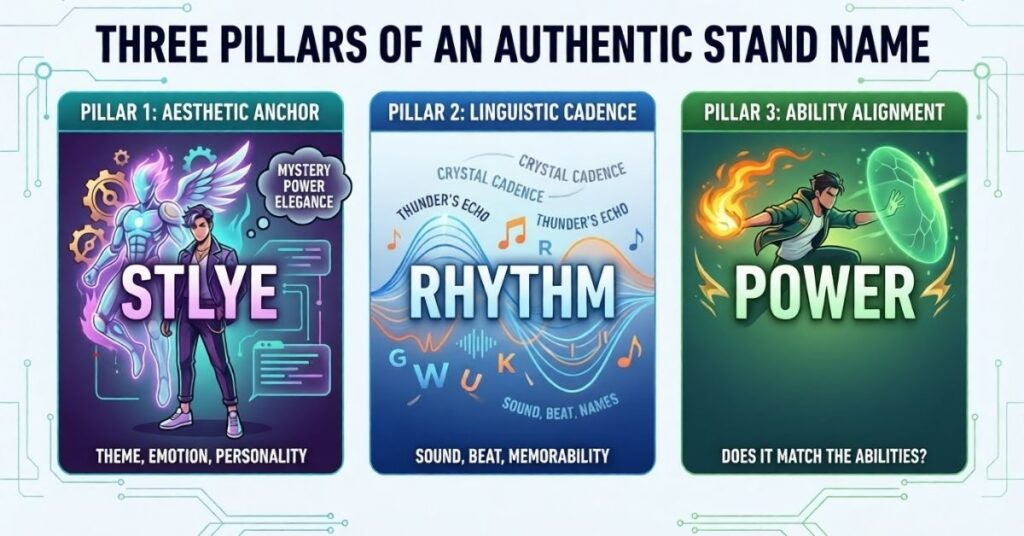
Pillar 1: Aesthetic Anchor
Every great Stand name has a “home base,” a theme it pulls from. That could be a musical genre (hard rock, jazz standards, hip-hop tracks), a mythological or religious reference, an industrial or mechanical vocabulary, or an aesthetic built around decay, royalty, or weather.
The Aesthetic Anchor is the lens the entire name gets filtered through. Without it, you’re just picking words because they sound tough, which is exactly the trap generic generators fall into.
When you use a dedicated naming tool, defining this anchor first changes the entire output quality. A musical anchor produces names like “Velvet Underground” or “Crimson Tide.”
An industrial anchor produces something closer to “Iron Maiden” (yes, also a band Araki loves double-dipping) or “Steel Ballad.” Pick the anchor before you pick anything else.
Pillar 2: Linguistic Cadence
Say “Star Platinum” out loud. Now say “Platinum Star.” The first one lands harder, and it’s not a coincidence; it’s syllable stress and word order. Two-beat, three-beat, and four-beat names each carry a different weight.
Short, punchy names (“Echoes,” “Hermit Purple”) work for subtler, more cerebral Stands. Longer phrase-style names (“Dirty Deeds Done Dirt Cheap,” “Sticky Fingers”) work for Stands with bigger personalities or more chaotic abilities.
A name generator that ignores cadence will hand you grammatically correct but rhythmically dead combinations. The good ones weigh word order and syllable count so the output actually sounds right when spoken aloud, not just when read silently on a screen.
Pillar 3: Ability Alignment
This is the pillar most beginners skip, and it’s the one that separates a forgettable name from a memorable one. The name shouldn’t just sound cool in isolation; it should hint at what the Stand actually does.
“The World” suggests time and totality before you ever see Dio use it. “Crazy Diamond” suggests something sharp, valuable, and a little unstable, which lines up with Josuke’s restorative-but-volatile power.
When you’re working with a JoJo stand generator with abilities, this is the step that ties the cosmetic name to the functional power. If your Stand manipulates gravity, an aquatic or musical reference probably won’t land; something tied to weight, pressure, or falling will feel earned instead of arbitrary.
Put those three pillars together—theme, rhythm, and meaning—and you get a name that survives scrutiny instead of just sounding good for five seconds.
Case Study: Creating an Original Stand Name with AI
To see how the process works in practice, let’s walk through a simple example.
Imagine you want a Stand that manipulates gravity. You also want it to feel mysterious rather than destructive, with inspiration drawn from classic rock and cosmic imagery.
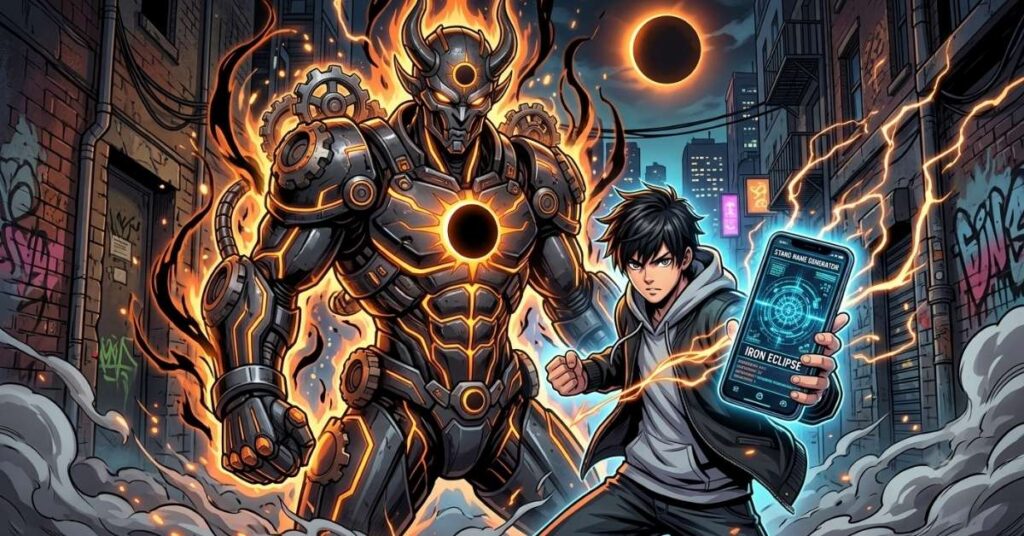
Instead of asking the AI to “generate a Stand name,” you provide structured inputs:
- Theme: Classic rock and space
- Ability: Gravity manipulation
- Tone: Mysterious and intimidating
- Length: Two to three words
- Avoid: Existing song titles and band names
In this example, the AI starts by identifying the ideas naturally associated with gravity, such as weight, orbit, collapse, and attraction. It then combines those concepts with a rhythmic naming style inspired by JoJo while avoiding direct references to existing songs or bands.
One possible result is Iron Eclipse.
The name works because Iron suggests strength and weight, while Eclipse hints at overwhelming celestial forces without explicitly describing the ability. Together, the words create a memorable rhythm and subtly reinforce the Stand’s power.
This example follows the same three-pillar framework discussed throughout this guide. The theme provides the aesthetic anchor, the word order creates a strong cadence, and the meaning aligns naturally with the Stand’s ability. Instead of combining random words, the AI builds a name that feels intentional and consistent with the naming style seen throughout the JoJo universe.
Recommended: Ultimate AI Selfie Generator Guide: What Actually Works in 2026
Step-by-Step: How to Generate Your Ideal Stand Name
Once you understand the methodology, actually using a generator becomes much faster. Here’s the practical workflow.
Example AI-Generated Stand Names
| Theme | Ability | Generated Name |
| Time | Time Stop | Hollow Sonata |
| Gravity | Crush | Iron Requiem |
| Fire | Burn | Crimson Orbit |
| Sound | Echo | Phantom Resonance |
| Ice | Freeze | Frozen Nocturne |

Step 1: Define Your Core Theme or Power Mechanic
Before you touch any tool, answer two questions: what does your Stand actually do (offense, defense, manipulation, support), and what aesthetic do you want it tied to (music, decay, royalty, nature, machinery)? Write both down in plain language.
This becomes your Aesthetic Anchor from the methodology above.
Step 2: Input Specific Prompt Tags Into the AI Tool
Vague prompts produce vague names. Instead of typing “give me a Stand name,” structure your input with tags: theme, power type, tone, and length preference.
Example Prompt
Generate an original JoJo-inspired Stand name.
Theme: 80s rock
Ability: Time manipulation
Tone: Ominous
Length: 2–3 words
Avoid existing song or band titles. Prioritize strong rhythm and ability alignment.
This is also where a how to name a stand search usually leads people astray; they look for a magic single prompt instead of learning to layer tags.
Step 3: Filter Results by Linguistic Style
Generate a batch of ten to fifteen names, then run them through the cadence test from Pillar 2; say each one out loud.
Cut anything that stumbles on the tongue or sounds like two random words stapled together. You should be left with two or three finalists that actually sound like they belong in a fight scene.
What Makes Stand Names Memorable?
A review of canonical Stand names alongside recurring themes discussed within the fan community reveals several patterns that consistently appear in memorable Stand names.
A few patterns stood out clearly enough to shape how a generator should weight its output.
| Factor | Finding |
| Syllable count | Names with 3–5 syllables appear more memorable; names over 7 syllables often become harder to remember in recall |
| Reference type | Musical references are generally perceived as more authentic than purely invented words and often feel closer to canonical Stand names. |
| Word order | Using nouns first can feel punchier than using adjectives heavily. |
| Ability hints | Names that subtly imply the power tend to feel more meaningful than names with no connection to the ability. |
| Repetition/alliteration | Alliteration makes names easier to remember without compromising clarity |
| Length consistency | Mixed-length names generally feel more balanced than two words of identical length. |
The clearest takeaway: people don’t just want a name that sounds cool in a vacuum. They want a name that does two jobs simultaneously: sound good and mean something. That’s consistent with everything the three-pillar methodology predicts, which is reassuring rather than surprising. Good naming isn’t a mystery; it’s a pattern that holds up when you actually measure it.
Frequently Asked Questions
What is a stand name generator AI, exactly?
It’s a tool that uses structured prompts and thematic databases, including music, mythology, tarot, and industrial language, to create original Stand-style names instead of combining random, unrelated words.
Can I use AI-generated Stand names commercially or in my own original work?
Yes. Names created through an original, theme-based approach are generally suitable for fan projects, original fiction, or your own IP because they don’t directly copy existing song or band titles. Before publishing or selling your work, it’s still a good idea to run a quick trademark check to make sure the final name doesn’t match an existing protected title.
How does Hirohiko Araki actually name his Stands?
Hirohiko Araki draws inspiration from rock, punk, and pop music, often borrowing band names and song titles alongside tarot, mythology, and cosmic references. For international releases, many names are slightly altered to avoid trademark issues, which is why an AI stand name maker should understand localization patterns rather than simply translating names.
Does an AI stand name generator support both English and localized Japanese-style names?
Yes. A well-built generator can produce both English-style and localized Japanese-inspired names. Because localization follows recognizable naming patterns, the AI can generate variations that feel natural while preserving the intended tone.
Why do some AI-generated Stand names sound cool but still feel wrong?
In most cases, the problem is rhythm and cadence rather than word choice. Two strong words can still sound awkward if they don’t flow naturally when spoken aloud. The best tools balance word order, syllable count, and pronunciation so each name feels memorable and closer to the style seen throughout JoJo.
Can AI generate original JoJo-style Stand names without copying existing names?
Yes. A well-designed AI Stand Name Generator analyzes naming patterns instead of copying existing songs, bands, or other references. With a detailed prompt, it creates original names that capture the same tone, rhythm, and thematic style without directly reusing copyrighted titles.
What prompt gives the best results in an AI Stand Name Generator?
The best prompts are highly specific. Include your Stand’s ability, theme, personality, preferred tone, and desired name length. For example: “Generate 10 JoJo-style Stand names for a time-manipulation Stand. Use musical or tarot-inspired references, make each name unique, and include a one-sentence explanation of how it matches the Stand’s ability.” The more context you provide, the more relevant and authentic the results will be.
Conclusion
A great Stand name isn’t luck; it’s three things lining up at once: a clear thematic anchor, a rhythm that lands when spoken, and a meaning that mirrors what the power actually does.
Generic random-word tools skip all three and hand you noun salad. A well-designed Stand Name Generator AI works best when it follows recognizable naming patterns instead of relying on random word combinations.
Start with your theme, get specific with your prompt tags, and always say the finalists out loud before you commit. Do that, and whatever you land on won’t just sound like a name; it’ll sound like it was always meant to belong to your Stand.
Experiment with different themes, refine your prompts, and don’t settle for the first result. The most memorable Stand names usually emerge after a few thoughtful iterations.

Qasim Ali is a Lead AI Solutions Architect and the founder of TechyPulse, with over 12 years of experience in enterprise digital transformation. Holding an MSc in Computer Science, he specializes in making Artificial Intelligence, Cybersecurity, and Machine Learning accessible and scalable. Qasim is dedicated to decoding complex neural networks into actionable insights for the modern technical landscape.